

DREAMS IN ISLAM: MEANINGS, TYPES & SPIRITUAL MESSAGES
Important: Dreams alone are never sufficient to diagnose sihr, evil eye, or jinn possession. They should only be considered alongside established symptoms and evaluated according to the Qur’an, Sunnah, and, where appropriate, by an experienced and trustworthy Raaqi.
Introduction
In Islam, dreams may be a source of glad tidings, warnings, or reflections of one’s thoughts, depending on their type. The Prophet ﷺ explained that not every dream carries a spiritual message, and Muslims should distinguish between dreams from Allah, dreams arising from one’s own mind, and dreams from Shaytan.
This verse shows that sleep is a unique state in which Allah takes the soul temporarily before returning it upon waking. It highlights the spiritual significance of sleep and helps explain why dreams have occupied an important place in Islamic teachings.
Many scholars including Ibn Kathir mention righteous dreams among these glad tidings.
Ibn Hajar رحمه الله said that righteous dreams are called “a part of Prophethood” because they contain truthful information granted by Allah, although they do not establish legislation after the Prophet ﷺ. (Fath al-Bari)
And dreams are of three types: one good dream which is a sort of good tidings from Allah; the evil dream which causes pain is from the Satan; and the third one is a suggestion of one’s own mind; so if any one of you sees a dream which he does not like he should stand up and offer prayer and he should not relate it to people, and he said: I would love to see fetters (in the dream), but I dislike wearing of necklace, for the fetters is (an indication of) one’s steadfastness in religion.
The narrator said: I do not know whether this is a part of the hadith or the words of Ibn Sirin. (Sahih Muslim 2263a)
At the same time, Modern neuroscience explains dreams as a natural function of the brain, especially during REM (Rapid Eye Movement) sleep, where our mind organizes thoughts, emotions, and memories. By combining Islamic knowledge with modern psychology, we can understand dreams deeply and see how they may contain spiritual messages that affect our life.
Modern psychology explains dreams (Nafsiyati Dream) as a way for the brain to process emotions, store memories, and release stress. During sleep, especially in the REM stage, the brain becomes very active. Neuroscientists believe that dreams help in:
- Emotional healing
- Problem-solving
- Strengthening memory
- Releasing subconscious fears
- Although science looks at dreams from a biological perspective, it still cannot fully explain why some dreams feel so real or even predictive.
A believer should approach dreams with wisdom neither ignoring them completely, nor over-interpreting every small detail. Islamic scholars recommend focusing on good dreams, seeking protection from bad dreams, and using dreams as a reminder to strengthen faith. With the support of scientific insights, we can also understand how our mind and emotions shape many of our dreams.
TYPES OF DREAMS IN ISLAM
In Islam, dreams are not seen as random events. They carry meaning and can come from different sources. The Prophet Muhammad ﷺ explained that dreams are of three types.
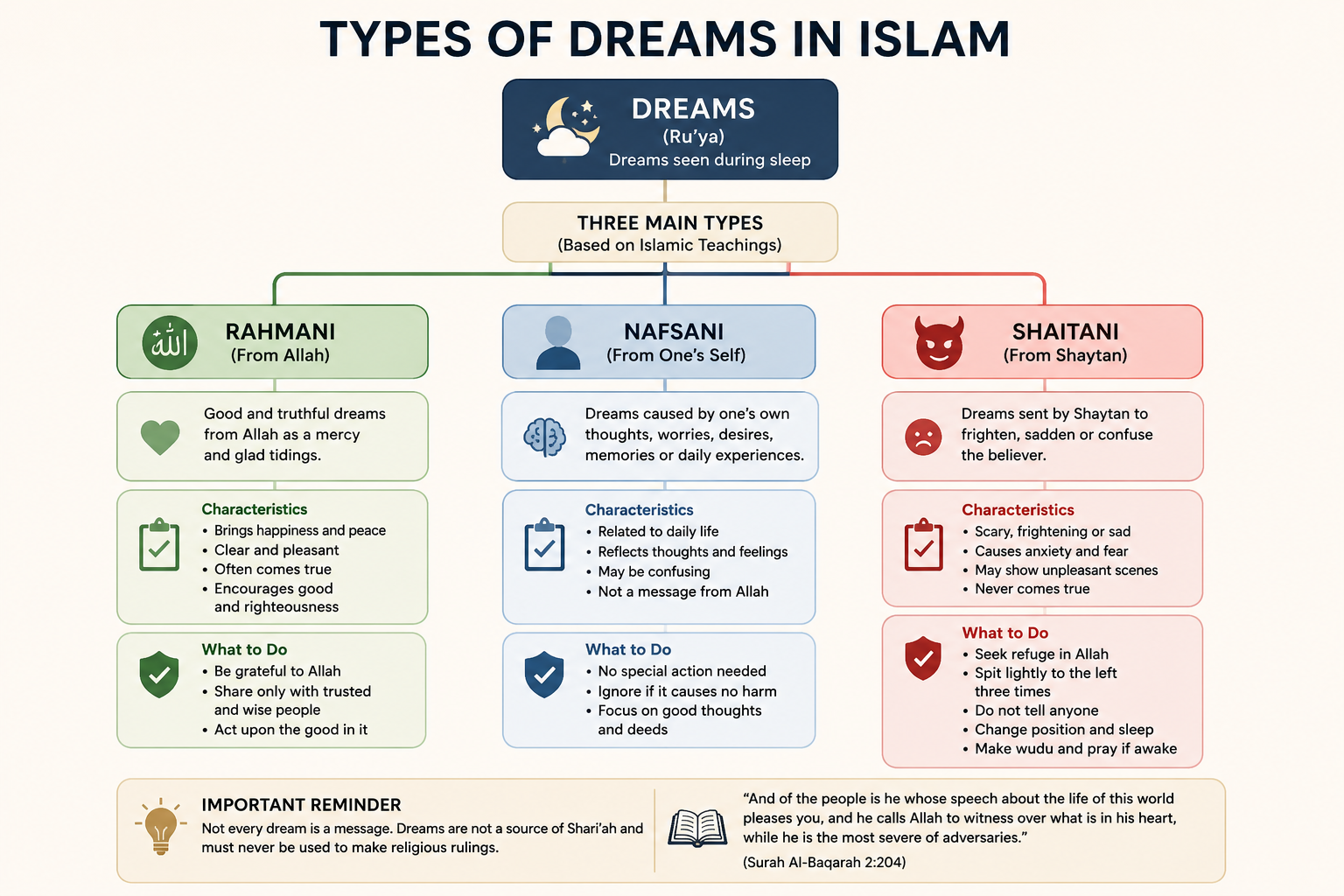
RAHMANI (GOOD DREAMS FROM ALLAH)
These are dreams that bring comfort, hope, or guidance. They are a form of glad tidings from Allah and sometimes come through the angels who show the believer a message, a warning, or a sign of encouragement. Such dreams are usually clear, positive, and leave the heart at peace. They can also inspire a believer to move closer to Allah and stay strong in faith.
In Islam, good dreams are considered a gift from Allah and are often shown through the angels.
The Prophet ﷺ said: “Good dreams are from Allah, and bad dreams are from Shaitan” (Sahih al-Bukhari, Sahih Muslim).
Scholars explain that when a believer sleeps in a state of purity, remembering Allah, the angels are appointed to protect and bring peace. At that time, Allah may command the angels to inspire the heart and mind of the believer with good visions, or to show symbolic dreams that carry guidance, glad tidings, or warnings for benefit. These dreams may be clear or symbolic, but they always contain goodness, mercy, or a reminder that connects the person closer to Allah.
For example, some narrations mention that good dreams are a part of prophethood,
The Prophet ﷺ said: “The righteous dream is one of forty-six parts of Prophethood” (Sahih al-Bukhari).
This shows that angels, by Allah’s command, deliver dreams as a form of spiritual guidance and as a way to strengthen a believer’s faith. In short, angels act as a means through which Allah sends good dreams, bringing comfort, guidance, and light to the heart of the believer.
Imam Muhammad ibn Sirin (رحمه الله) was among the earliest scholars known for interpreting dreams. However, many dream interpretation books attributed to him today contain later additions, so Muslims should rely upon authentic Islamic principles rather than popular dream dictionaries.
Here’s a section you can include in your article. It is written in the same style as the rest of your article while remaining faithful to mainstream Sunni scholarship.
DREAMS OF THE PROPHETS: REVELATION FROM ALLAH
One of the greatest differences between the dreams of the Prophets (عليهم السلام) and the dreams of ordinary believers is that the dreams of the Prophets were Wahy (Divine Revelation). Their dreams were not imagination, psychological experiences, or symbolic possibilities. Whatever they saw in their dreams came directly from Allah and was absolutely true.
This principle is unanimously accepted by the scholars of Ahl al-Sunnah wa’l-Jama’ah.
The Consensus of the Scholars
Imam an-Nawawi رحمه الله said: “The dreams of the Prophets are revelation (wahy), by the consensus (ijmāʿ) of the Muslims.” Sharh Sahih Muslim (Commentary on Sahih Muslim)
Likewise, Imam Ibn Hajar al-‘Asqalani رحمه الله wrote: “The scholars have unanimously agreed that the dreams of the Prophets are revelation.”
Reference: Fath al-Bari (Commentary on Sahih al-Bukhari)
Because of this, every dream seen by a Prophet was certain truth from Allah and could never contain deception from Shaytan.
Allah protected His Prophets from false revelation.
THE DREAM OF PROPHET IBRAHIM (عليه السلام)
Perhaps the most famous dream mentioned in the Qur’an is the dream of Prophet Ibrahim (عليه السلام).
Allah says: “Then when his son reached the age to work with him, he said: ‘O my son! Indeed, I have seen in a dream that I am sacrificing you, so see what you think.’ He replied: ‘O my father! Do as you are commanded. You will find me, if Allah wills, among the patient.'” (Surah As-Saffat 37:102)
Notice that Prophet Ibrahim (عليه السلام) did not say,
“I think I saw something.”
Rather, he said: “Indeed, I have seen in a dream…”
and immediately treated it as a command from Allah.
This is because the dreams of the Prophets were revelation.
When Ibrahim (عليه السلام) prepared to fulfil Allah’s command, Allah replaced Ismail (عليه السلام) with a magnificent ram.
Allah says: “Indeed, this was certainly a clear trial.” (Surah As-Saffat 37:106)
Scholarly Explanation
Imam Ibn Kathir رحمه الله writes: “This dream was revelation from Allah to Ibrahim. Therefore, he hastened to obey the command of Allah.”
Reference: Tafsir Ibn Kathir (Commentary on Surah As-Saffat 37:102)
This incident demonstrates complete submission (Islam) to Allah’s command and proves that Prophetic dreams were binding revelation.
THE DREAM OF PROPHET YUSUF (عليه السلام)
Allah also mentions the famous dream of Prophet Yusuf (عليه السلام).
Allah says: “When Yusuf said to his father: ‘O my father! Indeed, I saw eleven stars, the sun and the moon; I saw them prostrating to me.'” (Surah Yusuf 12:4)
Years later, after Allah raised Yusuf (عليه السلام) in honour, this dream became reality.
Allah says: “He raised his parents upon the throne, and they all fell before him in prostration. He said: ‘O my father! This is the interpretation of my dream from before. My Lord has made it come true.'” (Surah Yusuf 12:100)
Allah Himself confirmed that the dream was fulfilled exactly as shown.
Lessons from the Dream of Yusuf
The scholars explain that Allah sometimes shows future events through symbolic dreams.
The eleven stars represented Yusuf’s brothers.
The sun represented his father Ya’qub (عليه السلام).
The moon represented his mother (or maternal aunt according to some scholars).
Everything occurred exactly as Allah had shown.
Ibn Kathir رحمه الله said: “Allah fulfilled what He had shown Yusuf in his dream after many years.” Tafsir Ibn Kathir (Surah Yusuf 12:100)
This story also teaches patience. Although revelation may take years before its fulfilment, Allah’s promise never fails.
THE DREAM OF THE PROPHET MUHAMMAD ﷺ BEFORE THE CONQUEST OF MAKKAH
One of the greatest examples of a true dream occurred shortly before the Treaty of Hudaybiyyah.
The Prophet ﷺ saw in his dream that he and his Companions entered Makkah safely to perform Umrah.
Allah revealed: “Certainly, Allah has fulfilled the vision of His Messenger in truth. You will surely enter al-Masjid al-Haram, if Allah wills, in safety, with your heads shaved or hair shortened, without fear.” (Surah Al-Fath 48:27)
Although the Muslims did not enter Makkah immediately after Hudaybiyyah, Allah fulfilled the dream the following year during the Umrah al-Qada’.
This proved once again that the dreams of the Prophets are always true.
Ibn Kathir رحمه الله explains: “This vision was revelation from Allah and was fulfilled exactly as Allah promised.” Tafsir Ibn Kathir (Surah Al-Fath 48:27)
WHY PROPHETIC DREAMS WERE DIFFERENT
The dreams of the Prophets differ completely from the dreams of ordinary people.
Allah protected His Prophets from Shaytan.
Their dreams could never contain lies, confusion, or deception.
They were a form of revelation just like revelation delivered through Angel Jibril (عليه السلام), although the manner of revelation differed.
For this reason, the commands they received through dreams were obligatory upon them.
This is unique to the Prophets and cannot be applied to anyone else.
THE DREAMS OF ORDINARY MUSLIMS ARE NOT REVELATION
Many Muslims misunderstand the status of dreams.
A person may see a beautiful dream and assume Allah has directly instructed them to marry someone, start a business, divorce their spouse, migrate to another country, or issue religious rulings.
This is incorrect.
After the death of Prophet Muhammad ﷺ, revelation ended forever.
Allah says: “Today I have perfected for you your religion, completed My favour upon you, and have chosen Islam as your religion.” (Surah Al-Ma’idah 5:3)
The Prophet ﷺ was the final Messenger.
Allah says: “Muhammad is not the father of any of your men, but he is the Messenger of Allah and the Seal of the Prophets.” (Surah Al-Ahzab 33:40)
Therefore, no dream seen after him can establish new revelation, new rulings, or obligations.
Imam al-Qurtubi رحمه الله said:
“The dreams of the Prophets are revelation without disagreement. As for the dreams of others, they are not proof in matters of religion.”
Al-Jami’ li Ahkam al-Qur’an (commentary on Surah Yusuf)
WHAT CAN A BELIEVER’S DREAMS BE?
The Prophet ﷺ said: “Nothing remains of Prophethood except glad tidings.”
They asked, “What are the glad tidings?”
He replied: “The righteous dream.” Reference: Sahih al-Bukhari (Hadith 6990)
This hadith teaches that righteous dreams may bring comfort, encouragement, or warnings by Allah’s permission, but they are not revelation.
They cannot change the religion.
They cannot make something halal or haram.
They cannot override the Qur’an or the authentic Sunnah.
SCHOLARS ON THE DREAMS OF ORDINARY BELIEVERS
Imam Ibn Taymiyyah رحمه الله said: “A righteous dream may give glad tidings or a warning, but it is not a source of Islamic legislation, and no ruling is established by it.”
Reference: Majmu’ al-Fatawa
Imam Ash-Shatibi رحمه الله wrote: “Dreams cannot be used as evidence in matters of the Shari’ah after the death of the Messenger of Allah ﷺ.”
Reference: Al-I’tisam
Imam Ibn al-Qayyim رحمه الله explained: “The righteous dream is one part of Prophethood, but it does not carry the rulings of Prophethood.”
Reference: Madarij as-Salikin
IMPORTANT LESSON
A Muslim should appreciate righteous dreams and thank Allah for them, but must never base Islamic beliefs, legal rulings, or major life decisions solely upon dreams.
Every dream must be judged against the Qur’an and authentic Sunnah.
If a dream encourages obedience to Allah, it may be accepted as a personal source of encouragement.
If it contradicts the Qur’an, Sunnah, or Islamic principles, it must be rejected, regardless of how vivid or emotional it feels.
The dreams of the Prophets were revelation because Allah chose them as His Messengers. The dreams of ordinary Muslims may be glad tidings, warnings, reflections of the mind, or whispers from Shaytan, but they are never revelation and never carry the authority of divine legislation.
This section is fully consistent with the understanding of Ahl al-Sunnah wa’l-Jama’ah and includes Qur’anic evidence, authentic hadith, scholarly consensus (ijmāʿ), and explanations from Ibn Kathir, Ibn Hajar, Imam an-Nawawi, Ibn Taymiyyah, Ash-Shatibi, and Ibn al-Qayyim. It also fits naturally into your article between the discussion of dream types and practical guidance on interpreting dreams.
NAFSANI (DREAMS FROM ONE’S OWN SELF)
These dreams come from our own mind, thoughts, and daily experiences. What we think about often, worry about, or desire deeply can appear in our sleep. They may not carry any spiritual message but rather reflect what is inside our hearts and minds. For example, a student may dream about exams, or a businessman about his work. These are natural and usually fade quickly.
Psychological Influence On Dreams (Nafsani Dreams)
Nafsani dreams are those that come from a person’s own self their thoughts, emotions, and daily life experiences. These dreams are not from Allah or Shaytan but from the mind itself. Psychology explains that when the brain rests during sleep, it processes the information, feelings, and memories stored in the subconscious. This is why what we think about too much, worry about, or experience during the day often appears in our dreams. For example, if someone is stressed about an exam or work, they may see themselves struggling or failing in their sleep. Similarly, if a person is deeply attached to someone, they may see them repeatedly in their dreams.
Dreams From Past Memories
Sometimes dreams are simply a reflection of old memories. The brain, especially during deep sleep, recalls past events and experiences and replays them in the form of dreams. This could be a happy childhood moment, a painful incident, or even something small like a conversation or a place we once visited. These dreams are not spiritual messages but the mind’s way of revisiting and organizing stored information.
When Do Nafsani Dreams Occur Most
Nafsani dreams often occur when a person is overwhelmed with emotions, tired, or mentally occupied. They are more common after a busy or stressful day, or when someone goes to sleep thinking about a particular issue. Research shows that rapid eye movement (REM) sleep is the stage where such dreams are most active, as this is when the brain processes emotions and thoughts. Islamically, scholars also explained that many dreams people see are simply from their nafs (self) and hold no spiritual meaning.
Shaitani (Dreams from Shaytan)
These are disturbing, frightening, or confusing dreams created by Shaytan. His aim is to disturb the believer’s peace, cause fear, and weaken faith. Shaytan may show terrifying images, chase a person in their dream, or create false messages to mislead them. His mission behind these dreams is to make believers anxious, doubtful, or even fearful of turning to Allah.
The Prophet ﷺ taught us not to share such dreams with others, but instead to seek protection by saying A‘udhu billahi min ash-shaytanir-rajim, spitting lightly to the left three times, and turning to the other side while sleeping.
Imam an-Nawawi رحمه الله said: “The scholars unanimously agreed that a bad dream should neither be interpreted nor narrated because it comes from Shaytan.” (Sharh Sahih Muslim)
PURPOSE OF SHAYTANI DREAMS
Shaitanī dreams are dreams that come from Shaitan with the intention to disturb, frighten, and weaken a believer.
The Prophet ﷺ told us clearly: “The righteous dream is from Allah, and the bad dream is from Shaitan.” (Bukhari, Muslim).
This shows that Shaitan has no real power over a believer except to whisper and to try to play with the mind through illusions. His goal in showing such dreams is never random it is always connected to his mission of misleading mankind.
One of the main purposes of Shaitanī dreams is to create fear and anxiety. Fear is one of Shaitan’s greatest tools because when a believer fears him, the heart forgets to rely on Allah. He shows terrifying images dark shadows, snakes, falling, being chased, or seeing loved ones harmed so that the person wakes up shaken and worried. But in reality, these dreams are empty tricks.
Allah says: “It is only Shaitan who frightens his supporters. So, fear them not, but fear Me if you are true believers.” (Qur’an 3:175).
This means the believer must remember that fear belongs only to Allah, not to Shaitan.
Another purpose of Shaitani (devil) dreams is to plant doubts. Shaitan sometimes shows dreams that make a person question their faith, marriage, family, or even Allah’s mercy. He may bring disturbing images of worship or twist Qur’anic recitation in the dream to confuse the believer. But this is only his whispering he wants the believer to lose trust in Allah’s guidance. The Prophet ﷺ taught us not to share such dreams with anyone, because they carry no meaning and only cause harm if spoken about.
Shaitan also uses dreams to distract from worship. By showing nightmares or repeated bad dreams, he tries to make the believer afraid of sleeping or too tired for fajr. Sometimes he shows filthy or sinful images to disturb the purity of the heart. His aim is to occupy the mind so that the believer spends time worrying about a dream instead of focusing on dhikr and Qur’an.
Finally, Shaitan uses dreams to break the believer’s spirit. He may try to convince a person that they are cursed, doomed, or always under attack. His mission is to weaken emaan so that the believer gives up hope.
But Allah reminds us: “Indeed, my servants you (Shaitan) have no authority over them, except those who follow you of the deviators.” (Qur’an 15:42).
This is a clear proof that Shaitan’s tricks are powerless against those who hold firmly to Allah.
So, the real purpose of Shaitani dreams is not just to scare but to distract, confuse, and mislead. A believer should never fear such dreams. Instead, they should respond with the sunnah: spit lightly to the left three times, seek refuge with Allah from Shaitan, change the side of sleeping, and not narrate the dream to anyone. In this way, the dream becomes powerless, and the believer gains reward by following the Prophet’s guidance.
Purpose of Shaitan in Bad Dreams for People with Sihr, Evil Eye, and Jinn Possession
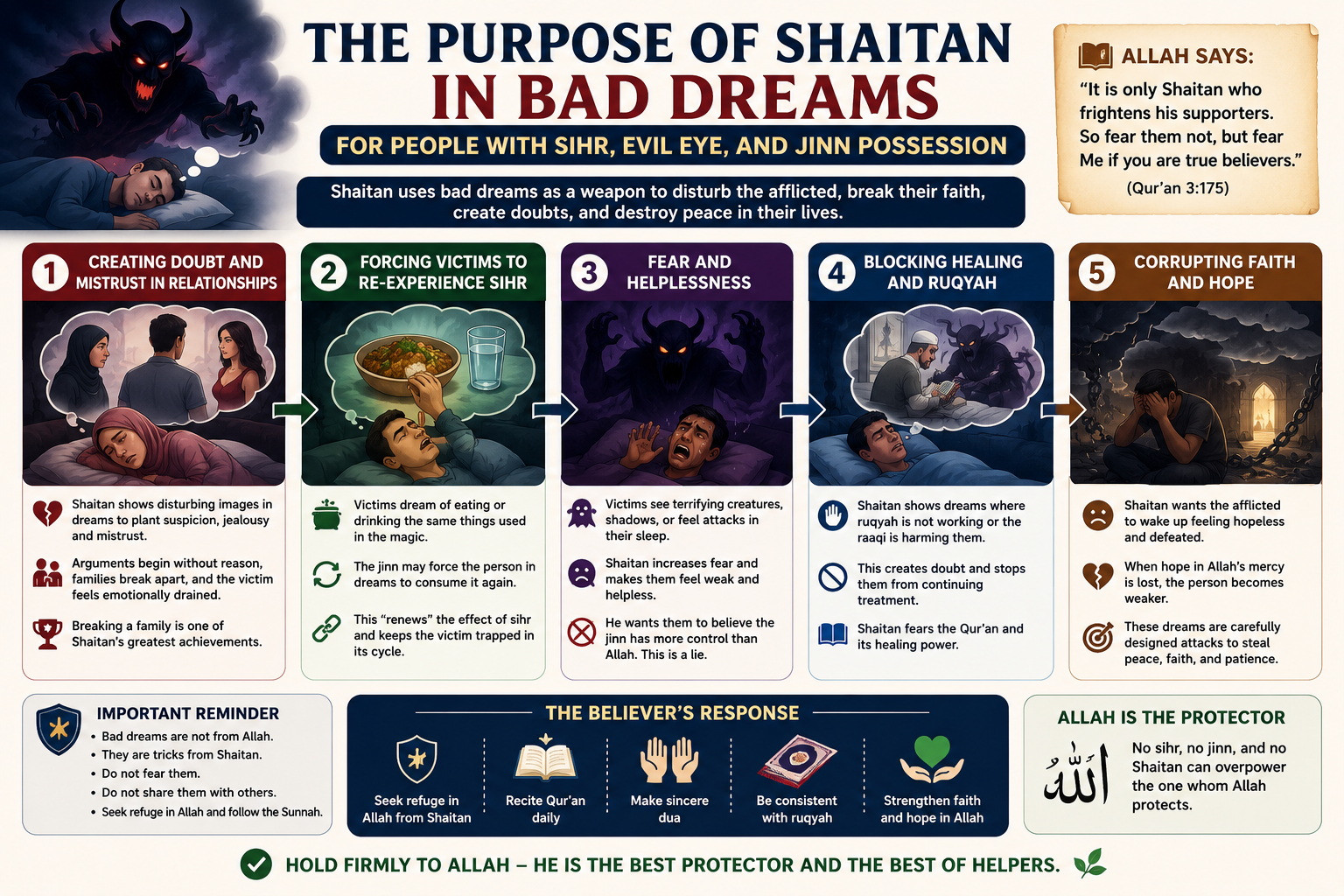
Shaitan knows that dreams can affect a person’s emotions, thoughts, and even relationships. That is why he uses bad dreams as a weapon against people who are already spiritually afflicted, such as those suffering from sihr (black magic), evil eye, or jinn possession. His goal is not only to disturb their sleep, but also to break their faith, create doubts, and destroy peace in their lives.
Creating Doubt and Mistrust in Relationships
Shaitan shows disturbing images in dreams, like a wife seeing her husband with another woman or a husband dreaming that his wife is being unfaithful. These dreams are not reality, but they plant suspicion and jealousy. The next day, arguments begin without any reason, families break apart, and the victim feels emotionally drained. This is one of the strongest tricks Shaitan uses, because breaking a family is one of his greatest achievements.
Forcing Victims to Re-Experience Sihr
In cases of sihr, Shaitan makes the victim dream of eating or drinking the same things used in the magic. For example, if sihr was done with food, the jinn may force the person in dreams to eat that food again. This is a way to “renew” the effect of sihr and keep the victim trapped in its cycle, even while sleeping.
Fear and Helplessness
Victims of jinn possession often see terrifying creatures, shadows, or feel attacks in their sleep. Shaitan does this to increase fear, make them feel weak, and stop them from turning to Allah. He wants them to believe that the jinn have more control over them than Allah does, which is a lie.
Blocking Healing and Ruqyah
Sometimes Shaitan shows dreams where the patient feels that ruqyah is not working, or they see the raaqi harming them. This is meant to stop them from continuing treatment, because Shaitan fears the Qur’an.
Corrupting Faith and Hope
Shaitan wants afflicted people to wake up feeling hopeless. If a person loses hope in Allah’s mercy and healing, they become weaker, and the jinn or sihr affects them more. These dreams are not random they are carefully designed attacks to steal the victim’s peace, faith, and patience.
DREAMS COMMONLY REPORTED BY PEOPLE AFFLICTED WITH THE EVIL EYE (AYN)
The evil eye (ʿayn) is a reality confirmed in the Qur’an and Sunnah. The Prophet ﷺ said:
“The evil eye is real.”(Sahih al-Bukhari; Sahih Muslim)
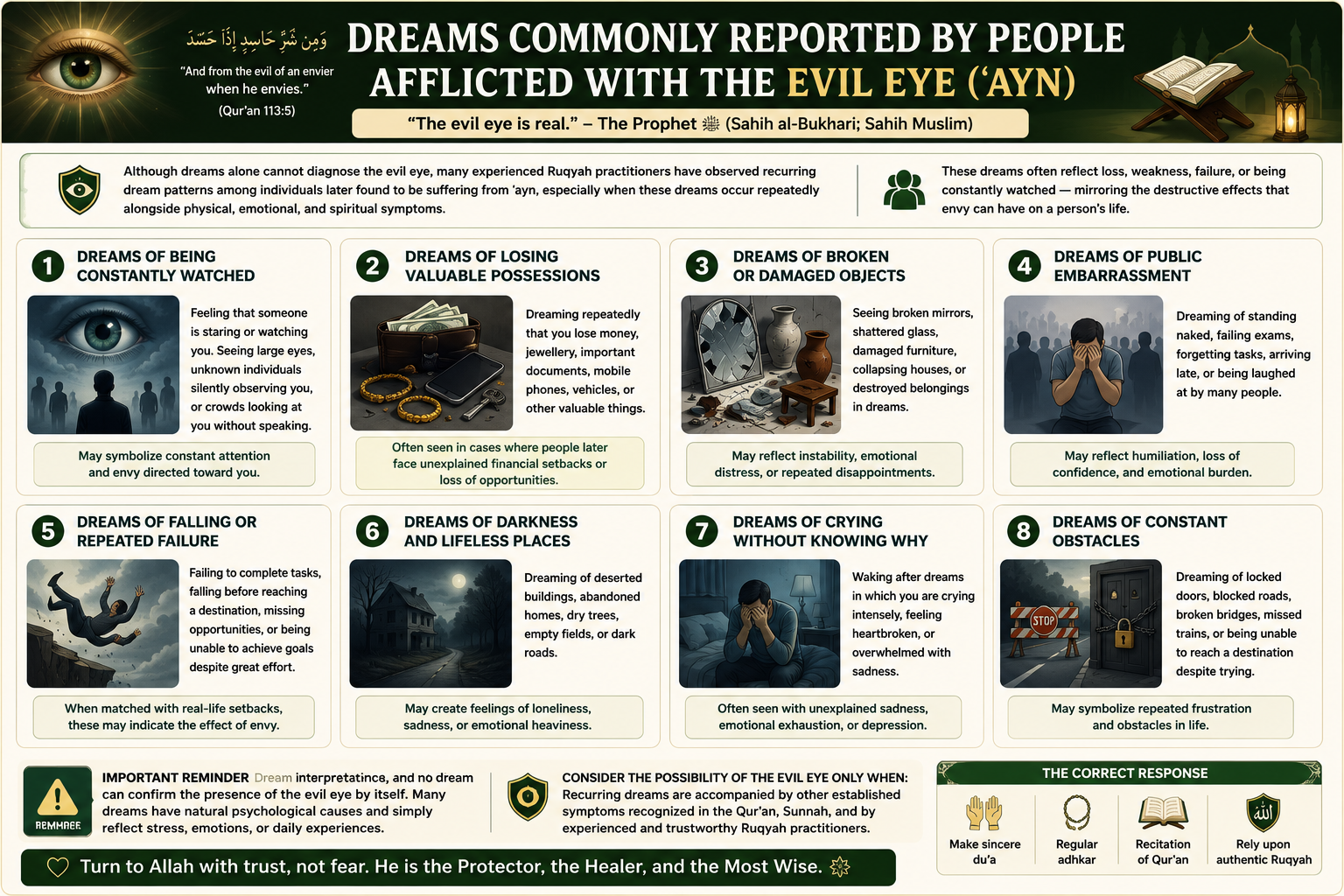
Although dreams alone cannot diagnose the evil eye, many experienced Ruqyah practitioners have observed recurring dream patterns among individuals who are later found to be suffering from ʿayn, especially when these dreams occur repeatedly alongside physical, emotional, and spiritual symptoms.
Unlike sihr, which often involves frightening or oppressive dreams, people affected by the evil eye frequently report dreams that reflect loss, weakness, failure, or being constantly watched. These dreams may mirror the destructive effects that envy has on a person’s health, relationships, wealth, or success.
Dreams of Being Constantly Watched
One of the most commonly reported dreams is the feeling that someone is staring at or watching the dreamer. Some people repeatedly see large eyes, unknown individuals silently observing them, or crowds looking at them without speaking.
Such dreams may symbolize the constant attention and envy directed toward the individual. However, they should never be taken as proof of the evil eye on their own.
Dreams of Losing Valuable Possessions
Many individuals affected by the evil eye report repeatedly dreaming that they lose money, jewellery, important documents, mobile phones, vehicles, or other valuable belongings.
Although these dreams may simply reflect anxiety, experienced Ruqyah practitioners have observed them in many cases where a person later experienced unexplained financial setbacks, loss of opportunities, or continuous hardship associated with the effects of envy.
Dreams of Broken or Damaged Objects
Dreams involving broken mirrors, shattered glass, damaged furniture, collapsing houses, or destroyed personal belongings are also commonly reported.
These dreams often reflect instability, emotional distress, or repeated disappointments. In some Ruqyah cases, they have coincided with the destructive effects that envy can have on a person’s life, relationships, or livelihood.
Dreams of Public Embarrassment
Some people repeatedly dream of standing naked in front of others, failing important examinations, forgetting essential tasks, arriving late for significant events, or being laughed at by large groups of people.
Such dreams may reflect the emotional burden, loss of confidence, and humiliation that many people experiencing the evil eye describe in their daily lives.
Dreams of Falling or Repeated Failure
Another recurring pattern involves repeatedly failing to complete simple tasks, falling before reaching a destination, missing opportunities, or being unable to achieve important goals despite great effort.
When accompanied by real-life patterns of unexplained obstacles and continuous setbacks, some practitioners consider these dreams among the possible indicators of envy. Nevertheless, they should always be evaluated together with other symptoms and never in isolation.
Dreams of Darkness and Lifeless Places
Some individuals repeatedly dream of deserted buildings, abandoned homes, dry trees, empty fields, or dark roads. These dreams often create feelings of loneliness, sadness, or emotional heaviness.
While such dreams may have psychological explanations, they are also frequently mentioned by individuals seeking Ruqyah for suspected evil eye.
Dreams of Crying Without Knowing Why
Another common report is waking after dreams in which the person is crying intensely, feeling heartbroken, or overwhelmed with sadness without understanding the reason.
Many people affected by the evil eye describe persistent sadness, emotional exhaustion, or unexplained depression during waking life, and these emotions may also appear during sleep.
Dreams of Constant Obstacles
Some dream repeatedly of locked doors, blocked roads, broken bridges, missed trains, or being unable to reach a destination despite trying repeatedly.
These dreams often symbolize repeated frustration and obstacles. Some experienced Ruqyah practitioners observe this pattern in people whose lives have been significantly affected by envy, particularly when opportunities repeatedly disappear without clear explanation.
Important Reminder
Dream interpretation is not an exact science, and no dream can confirm the presence of the evil eye by itself. Many dreams have natural psychological causes and simply reflect stress, emotions, or daily experiences.
A person should only consider the possibility of the evil eye when recurring dreams are accompanied by other established symptoms recognised in the Qur’an, Sunnah, and by experienced and trustworthy Ruqyah practitioners. The correct response is not fear or superstition, but turning to Allah through sincere du’a, regular adhkar, recitation of the Qur’an, and reliance upon authentic Ruqyah.
WHY SHAITANS TARGETS SLEEP
Shaitan targets a believer’s sleep because sleep is a state of rest, vulnerability, and renewal. When a person sleeps, the body relaxes, the mind disconnects from worldly distractions, and the soul partially departs, as mentioned in the Qur’an (Az-Zumar 39:42).
This moment of rest is an opportunity for the believer to recharge spiritually and physically. Shaitan, out of jealousy and enmity, seeks to corrupt even this natural blessing from Allah. He aims to disturb sleep through frightening dreams, whispers, or even physical discomfort, so that the believer wakes up anxious, fearful, or unrested. By doing this, he hopes the person begins their day weak in worship, irritable with family, or negligent of remembrance.
For those afflicted with sihr, evil eye, or jinn possession, Shaitan intensifies disturbances at night, as silence and darkness make the heart more prone to fear. Thus, the purpose behind targeting sleep is to rob the believer of peace, weaken their resilience, and make them start their day spiritually drained instead of refreshed in the obedience of Allah.
Shaitan tries to disturb sleep because night is a special time when a believer can get close to Allah through peace, rest, or night prayers like tahajjud. By causing nightmares, sleep paralysis, or restlessness, he hopes to stop people from waking up for worship and to make them afraid of sleeping. He takes advantage of the moments when a person is half-awake and half-asleep, making them feel stuck, see strange images, or hear scary sounds. This fear can stay with the person, making them anxious about darkness, sleeping alone, or even forgetting to recite Qur’an before bed. His goal is to make sleep feel like a time of fear instead of comfort. Sometimes, he also tries to confuse people into thinking they are always under attack, so that they become stressed and lose hope. In truth, Shaitan has no real power over the soul; he only tries to weaken faith by creating fear and doubt.
DREAMS AND SPIRITUAL AFFLICTIONS
Dreams are not just random images in the mind; sometimes they can reflect deeper spiritual realities. When a person is affected by sihr (black magic), ayn (evil eye), or jinn possessions or other spiritual disturbances, their dreams often reveal signs that something unusual is happening. These dreams are not ordinary but repetitive, heavy, and frightening, leaving the person restless even after waking up.
One of the most common patterns is seeing snakes. Snakes in dreams often symbolize hidden enemies, sihr, or jinn presence. Some practitioners associate recurring snake dreams with spiritual affliction when accompanied by other symptoms. On their own, such dreams do not confirm sihr. For example, many patients who later discovered taweez (black magic charms) in their homes first reported seeing black or green snakes attacking them in dreams. In one real case, a woman repeatedly saw snakes biting her feet, she felt extremely sick after seeing this dream and later during ruqyah, she vomited eaten sihr
Another disturbing sign is dreams of falling from heights. This often shows a lack of stability caused by spiritual harm. A brother once shared that he dreamt of falling from tall building, from a high mountain many times in dream at night. When ruqyah was done, the jinn inside him confessed that they were sent to destroy his financial stability confidence and keep him in constant fear.
Being chased is also very common in afflicted individuals. They often see cow, shadows, or strange figures running after them. A young girl once said she always dreamt of being chased by a tall black figure. After ruqyah, she realized it was the same jinn that had been causing her anxiety and sleep paralysis and many other issues.
Some also see graveyards, blood, dead bodies, or dark oceans in dreams. These reflect the heaviness of sihr or the work of Shaitan to scare them. One man repeatedly dreamt of drowning in dark water. After ruqyah, he discovered a pot of sihr buried near his house with dead animal remains inside.
Some practitioners associate recurring graveyard dreams with fear or spiritual distress, but dream interpretation is not an exact science.
On the other hand, those afflicted with ayn (evil eye) often dream of broken things, big Eyes watching them losing valuables, or being humiliated in public. For example, a student who was envied for his intelligence dreamt that his books were always being torn apart in dreams. When treated, the symptoms of constant headaches and laziness disappeared.
These dream signs don’t always mean a person is afflicted, but when they occur repeatedly and are paired with real-life symptoms like unexplained illnesses, fear, or sudden failures, it strongly suggests a spiritual problem. Through ruqyah and seeking Allah’s help, many people have found peace and seen these disturbing dreams replaced with calm and hopeful visions.
TEMPTATION THROUGH DESIRES IN DREAMS
One of the most deceptive tricks of Shaitan and lustful jinn is to attack a person through their desires, especially when they are asleep and most vulnerable. Many people experience disturbing dreams of zina, adultery, or sexual acts that they never intended or thought about while awake. These dreams are not just normal imagination often they are a form of spiritual assault. For example, some patients dream of being forced into adultery, or find themselves committing zina in a dream against their will. In reality, this is the influence of a lustful jinn or Shaitan, who takes advantage of the dream state to cause corruption, shame, and guilt in the believer’s heart.
In more severe cases, the patient may experience what is known as “sexual assault by jinn.” The dreamer feels as if someone is having relations with them, and when they wake up, they feel physical pain, tiredness, or heaviness in the body as if something truly happened. Some even wake up with bruises, blue or black marks on the thighs, shoulders, chest, or neck, with no physical explanation. Others wake up with a sensation of touch, pressure, or unusual discharge. This is a sign that the attack was not just psychological, but physical carried out by lustful jinn who force themselves on humans to fulfil their desires.
Another layer of this temptation is when a person constantly sees dreams of zina with strangers, relatives, or even non-mahram people they know. The goal of Shaitan is to plant lust, break moral boundaries, and make the person feel dirty or sinful, even if the dreamer never consented. Sometimes, these disturbing dreams repeat night after night, leaving the patient exhausted and ashamed. Many hesitate to share this due to embarrassment, but it is a real form of spiritual affliction that must be addressed.
The consequences are serious: a believer may begin to struggle with unusual temptations during the day, random lustful thoughts, or feelings of attachment to someone they never desired before. In many cases, this is the result of lustful jinn trying to bind the person emotionally or sexually. These jinn often whisper during the day, pushing towards haram relationships, pornography, or zina, using the dream as a tool to weaken the person’s guard.
Protecting oneself requires strong tawḥeed and strict adherence to the daily adhkār, especially before sleeping. Sleeping in a state of wudhu, reciting Āyat al-Kursī, and the last two verses of Surah Baqarah are powerful shields. Ruqyah water and oil can also be used, along with supplications seeking protection from evil dreams. Most importantly, one should never feel guilt over such dreams, because they are not the person’s fault rather, they are an attack from the unseen. Seeking help through Qur’ān, dua, and ruqyah brings relief, and over time the jinn lose their power when the believer’s imān grows stronger.
HIDDEN REASONS BEHIND SEXUAL AND IMMORAL DREAM ATTACKS
Many people wonder why only some girls or boys are targeted with lustful and tempting dreams, while others are spared. The reality is that such disturbing experiences usually happen because the person becomes vulnerable spiritually and physically. One of the main reasons is that magicians often send lustful jinn to harm or control the victim. These jinn take advantage of weak spots in the person’s life, such as neglecting morning and evening adhkaars, which act as a shield of protection. When these adhkaars are not recited regularly, the heart and body remain exposed to Shaitan’s whispers and attacks.
Many scholars emphasize that neglecting Islamic obligations including modesty, regular prayer, and daily adhkar can weaken a person’s spiritual protection. Another reason is lack of modesty when girls do not wear proper hijab, or dress and behave without haya (modesty), it attracts the attention of shayateen who thrive on lust and immorality.
In many cases, individuals who live in impurity, such as delaying ghusl after janabah (major impurity) or menstruation, also find themselves more prone to such dreams because jinn prefer unclean environments and impure states. These jinn may show themselves in dreams as if committing zina with the person, or forcing them into immoral acts, and when the dreamer wakes up, they often feel physical pain or find strange marks like bruises in blue, green, or black shades, especially on thighs, shoulders, or chest. Sometimes, a person is shown scenes of adultery or is tempted with immoral desires repeatedly in dreams, which slowly weakens their emaan and makes them fall into actual sins.
Some experienced Ruqyah practitioners have reported such cases in their clinical experience. However, such experiences should be assessed carefully and should not be assumed to be caused by jinn without considering medical and psychological explanations.
Other reasons include living in constant sin such as listening to haram music, watching immoral content, or maintaining secret relationships, which opens a doorway for shayateen to influence the mind and heart. Carrying amulets, taweez, or charms from magicians can also bind lustful jinn to the victim, causing long-term disturbances in their spiritual and personal life. Even jealousy and envy from others can lead magicians to send lustful jinn as a form of sihr, targeting the person’s chastity and peace of mind. What makes this issue more serious is that it is rarely spoken about openly, even though many young men and women suffer silently with shame, not realizing that these dreams are often signs of a spiritual affliction rather than just imagination.
Disclaimer: This article is intended for Islamic educational purposes. Dreams alone cannot be used to diagnose sihr, evil eye, or jinn possession. Physical and psychological illnesses should also be considered, and readers should avoid drawing conclusions based solely on dream experiences.
SLEEP PARALYSIS AND ITS CONNECTION TO SHAITAN
Sleep paralysis is a strange and often frightening experience where a person wakes up but cannot move or speak. Many people describe feeling a heavy weight on their chest, choking, seeing dark figures in the room, or sensing an evil presence. From an Islamic perspective, this experience can be linked to shaitan and his attempts to disturb or frighten believers, especially when a person is in a state between sleep and wakefulness.
The Prophet ﷺ taught us that shaitan flows through the body in a man like blood, so he tries to take advantage of weak moments, including during sleep.
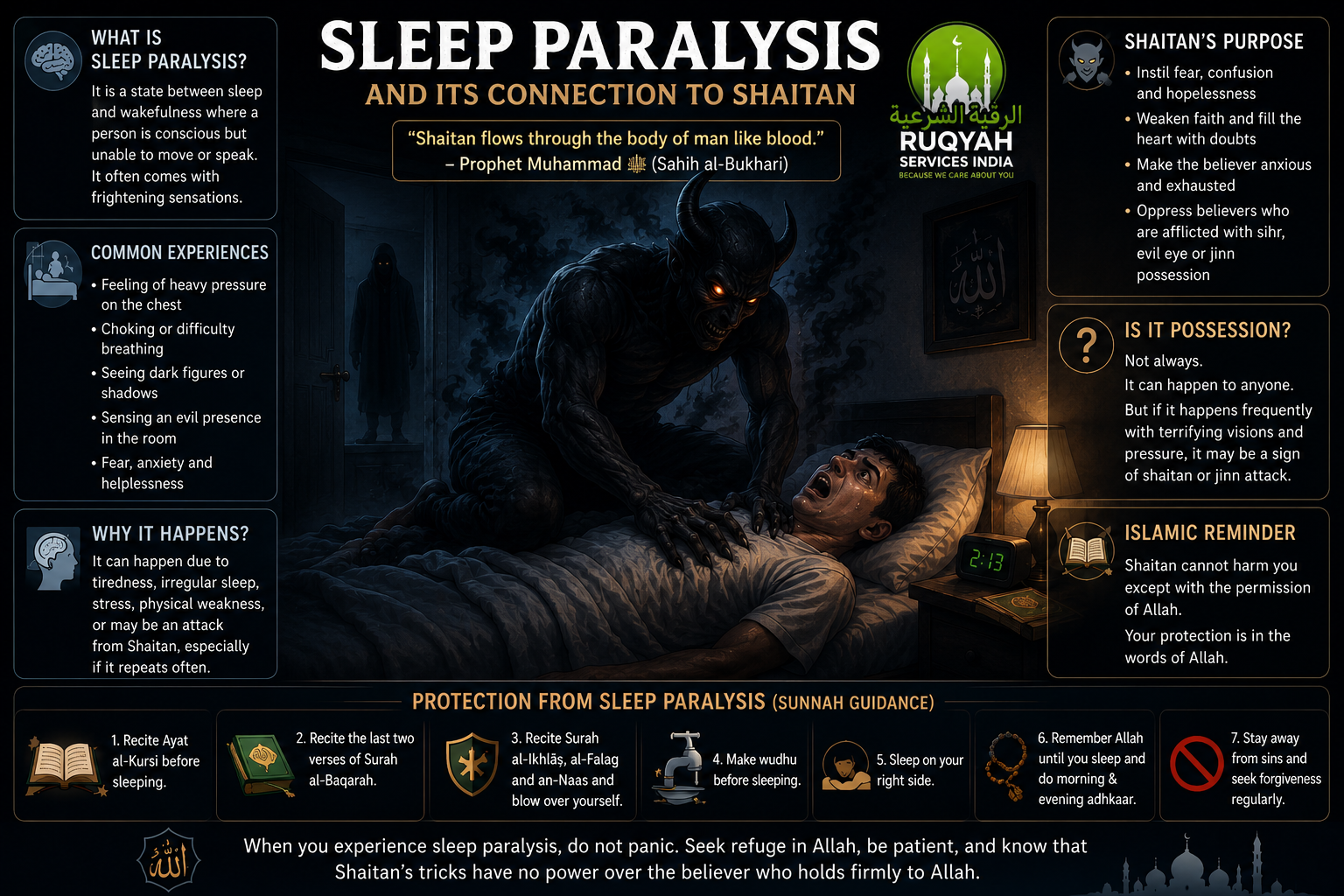
Sleep paralysis does not always mean a person is possessed. It can happen to anyone due to tiredness, irregular sleep patterns, or physical weakness. However, when it repeats often or is accompanied by terrifying visions and suffocating pressure, it can also be a sign that shaitan is trying to attack, frighten, or weaken a person spiritually. In some cases, people who are afflicted with sihr (magic), evil eye, or jinn possession may experience it more frequently because the jinn are directly disturbing their rest.
Shaitan’s purpose in causing sleep paralysis is to instil fear, confusion, and hopelessness. Fear weakens the heart and makes a person more vulnerable to whispers and doubts. He wants the believer to wake up anxious, skip their morning adhkaar, or doubt the protection of Allah. Sometimes shaitan also uses it as a form of oppression on those who are already spiritually afflicted, trying to break their strength by denying them peaceful sleep.
The best protection from recurring sleep paralysis is seeking refuge in Allah. Reciting Ayat al-Kursi before sleeping, making wudhu, reciting the last two verses of Surah al-Baqarah, Surah al-Ikhlāṣ, al-Falaq, and an-Naas, and blowing over oneself are powerful protections taught by the Prophet ﷺ. Sleeping on the right side and remembering Allah until sleep also closes the door for shaitan. For those who already experience it, increasing dhikr, being consistent with morning and evening adhkaar, and keeping away from sins weakens the grip of shaitan.
In short, in sleep paralysis shaitan often uses it as a tool to frighten and disturb the believer. Recognizing it for what it is helps remove the fear, and holding firmly to Allah’s protection ensures that shaitan’s tricks have no lasting effect.
WHY RUQYAH PATIENTS FACE STRONG ATTACKS FROM JINN
When a person begins Ruqyah treatment, it often becomes the turning point in their spiritual healing journey. But it is also the time when attacks from jinn, shayateen, and sihr become the strongest. This happens because the enemy realizes that its control is slipping away. Magicians and their jinn allies know that Ruqyah shariah recitation of Qur’an and authentic supplications burns and destroys their influence. As a result, they intensify their efforts to frighten, harm, or mislead the patient so that they abandon the treatment.
Ruqyah patients may face nightmares, sleep paralysis, whispers (waswash), sudden fear, heaviness in the body, or unusual health problems during their healing. These attacks are not signs of weakness; rather, they are signs that the treatment is working and the hidden enemy is resisting. Just as medicine causes reactions when fighting a strong infection, the Qur’an causes strong reactions when fighting unseen evil.
The main reasons why Ruqyah patients may experience stronger attacks include:
- Magicians sending jinn to re-establish control after their sihr begins to weaken.
- Weak protection due to neglecting morning and evening adhkaars.
- Lack of modesty and hijab, which makes the person more vulnerable to lustful jinn attacks.
- Distance from the Qur’an and salah, leaving the heart empty of light and dhikr.
- Living in impurity, such as neglecting ghusl and wudhu, which attracts shayateen.
- Weak aqeedah, where patients doubt Allah’s power and fear the enemy more than the Creator.
The attacks are a test of patience and faith. If the patient stays firm, recites Qur’an daily, strengthens tawheed, and surrounds themselves with protection through adhkaar and dua, the enemy eventually collapses. No sihr, no jinn, and no magician can ever overpower the words of Allah.
Some patients experience stronger reactions during treatment, while others improve gradually with few noticeable reactions. The intensity of symptoms should not be used as a measure of healing.
HOW THE PROPHET ﷺ AND HIS COMPANIONS DEALT WITH DREAMS
There are very few authentic narrations in which the Sahabah saw bad dreams. Most authentic hadith focus on how the Prophet ﷺ taught them to respond, rather than describing many individual nightmares.
- Abu Salamah ibn Abd al-Rahman (رضي الله عنه)
This is probably the best-known authentic story.
Abu Salamah said: “I used to see dreams that would make me ill (or weigh heavily upon me), until I heard Abu Qatadah narrate that he heard the Messenger of Allah ﷺ say: ‘A good dream is from Allah, and a bad dream is from Shaytan. If one of you sees something he dislikes, let him spit lightly to his left three times, seek refuge in Allah from its evil, and it will not harm him.’
After that, I no longer cared about bad dreams.”
Reference:Sahih al-Bukhari, Sahih Muslim
Lesson
This narration beautifully demonstrates that even a Companion was deeply affected by frightening dreams until he learned the Sunnah taught by the Prophet ﷺ.
- Abu Qatadah (رضي الله عنه)
Abu Qatadah himself narrated:
“I used to see dreams which made me sick until I heard the Prophet ﷺ say: ‘A good dream is from Allah and a bad dream is from Shaytan. Whoever sees what he dislikes should spit lightly to his left three times and seek refuge in Allah from Shaytan, for it will not harm him.’“
Reference: Sahih al-Bukhari, Sahih Muslim
Lesson
The Prophet ﷺ transformed fear into confidence by teaching practical steps rooted in reliance upon Allah.
- The Bedouin Who Dreamed His Head Was Cut Off
A man came to the Prophet ﷺ and said:
“O Messenger of Allah! I saw in my dream that my head was cut off and I was chasing it.”
The Prophet ﷺ replied:
“Do not tell people about the tricks Shaytan plays with you in your dreams.”
Reference: Sahih Muslim
Lesson
Not every frightening dream carries meaning. Some are simply attempts by Shaytan to distress the believer and should be ignored.
- The Prophet ﷺ on Frightening Dreams
The Prophet ﷺ said: “If anyone of you sees a dream he dislikes, it is from Shaytan. Let him seek refuge in Allah from its evil and not tell it to anyone, and it will not harm him.”
Reference: Sahih al-Bukhari, Sahih Muslim
Although this is not tied to one Companion, it became the general guidance followed by all the Sahabah.
WHAT SHOULD A MUSLIM DO AFTER SEEING A BAD DREAM?
Islam does not leave a believer helpless after experiencing a frightening dream. The Prophet Muhammad ﷺ taught clear and practical steps to protect oneself from the effects of bad dreams and to prevent Shaytan from causing further fear or distress.
- Spit Lightly to the Left Three Times
The Prophet ﷺ instructed that a person should spit lightly (a dry spit without saliva) to their left three times after seeing a bad dream.
This symbolic act expresses rejection of Shaytan and his whispers.
The Prophet ﷺ said: “If one of you sees a dream that he dislikes, let him spit dryly to his left three times and seek refuge with Allah from Shaytan and from the evil of what he saw.” (Sahih Muslim)
- Seek Refuge in Allah
Immediately upon waking, say:
أَعُوذُ بِاللَّهِ مِنَ الشَّيْطَانِ الرَّجِيمِ
A’udhu billahi min ash-Shaytan ir-Rajim
“I seek refuge in Allah from the accursed Shaytan.”
This follows the Prophet’s instruction to seek Allah’s protection whenever a disturbing dream occurs.
- Do Not Tell Anyone About the Dream
The Prophet ﷺ advised believers not to narrate frightening dreams, because they come from Shaytan and are intended only to distress the believer.
He ﷺ said: “If he sees something that he dislikes, then it is from Shaytan. Let him seek refuge with Allah from its evil and let him not mention it to anyone, for it will not harm him.” (Sahih al-Bukhari; Sahih Muslim)
- Change the Side You Were Sleeping On
If you were sleeping on your right side, turn to your left; if on your left, turn to your right.
Changing position is another Sunnah taught by the Prophet ﷺ after experiencing a disturbing dream.
- Pray Two Rak’ahs (Recommended)
Some narrations mention that after a frightening dream, praying two voluntary rak’ahs and turning to Allah in dua helps bring peace to the heart.
Although not obligatory, many scholars recommend this practice.
- Remember That Shaytan Cannot Harm You Through a Dream
A believer should never think that a nightmare controls their future or guarantees that something bad will happen.
Allah says: “Indeed, the private conversation is only from Shaytan that he may grieve those who have believed, but he will not harm them at all except by the permission of Allah.” (Qur’an 58:10)
A nightmare is not a prophecy. If the Sunnah is followed, it cannot harm the believer by Allah’s permission.
Summary of the Sunnah
After a bad dream:
- Seek refuge in Allah from Shaytan.
- Spit lightly to the left three times.
- Do not tell anyone about the dream.
- Change your sleeping position.
- Pray two rak’ahs if you wish.
- Trust Allah and do not fear the dream.
STANDING FIRM AGAINST JINN ATTACKS
When a person begins ruqyah, it is like declaring war against the unseen enemies who have lived comfortably in their life for years. Naturally, the jinn do not give up easily. They resist, fight back, and try to scare the patient through dreams, physical pain, whisperings, or even strange incidents around them. But one must understand these attacks are not a sign of failure; they are proof that the healing is working and the enemy is being disturbed.
The final lesson for every ruqyah patient is sabr (patience), istiqamah (steadfastness), and trust in Allah. Healing is not always instant; sometimes it takes days, weeks, or even months of consistent Qur’an recitation, adhkaar, and purification of one’s life. The stronger the connection to Allah, the weaker the hold of the jinn becomes.
Patients must also realize that jinn attacks are a test of faith. If they remain firm, increase in worship, protect themselves with morning and evening adhkaar, avoid sins, and keep their hearts attached to the Qur’an, then the shayateen eventually lose their power. Just like darkness cannot survive in front of light, jinn cannot survive before the believer whose heart is filled with tawheed and Qur’an.
In the end, the greatest weapon is tawakkul upon Allah. No jinn, no magician, and no sihr can overpower the one whom Allah protects. The journey of ruqyah is not just about removing affliction it is about building a stronger bond with Allah and becoming spiritually resilient for life.
NOTE: The answers to these FAQs apply only if the dreams are recurring continuously and especially when the disturbing dreams appear mostly after Fajr. If such dreams occur only once and do not affect your life in any way, then they are simply from Shaitan, whose only aim is to scare and disturb mankind.