
DIFFERENCE BETWEEN SIHR, EVIL EYE AND JINN POSSESSION
Have you ever wondered whether unexplained problems in your life are caused by Sihr (black magic), the Evil Eye (Al-‘Ayn), or Jinn possession? Many Muslims search for answers after experiencing persistent difficulties such as sudden changes in health, strained relationships, recurring nightmares, emotional distress, or unusual reactions during Ruqyah. Because these three matters are often discussed together, it is easy to confuse one with another.
The Qur’an and the authentic Sunnah affirm the reality of Sihr (Blackmagic), the Evil Eye, and the existence of Jinn. However, they are not the same phenomenon, and each has its own causes, characteristics, and Islamic rulings. Understanding the difference is essential to avoid misunderstanding symptoms, making incorrect assumptions, or seeking inappropriate treatment.
This guide explains these topics through the lens of the Qur’an, authentic Hadith, and the explanations of recognized Islamic scholars. It also highlights where Islamic texts provide clear evidence and where caution is needed because not every claim circulating online is supported by authentic sources.
The Confusion
One of the most common misconceptions is believing that every unexplained problem must be caused by Sihr, the Evil Eye, or Jinn possession. A person may experience fatigue, anxiety, family disputes, financial hardship, or recurring illness and immediately conclude that they have been affected spiritually. Others may assume that a frightening dream, sleep paralysis, or a strong emotional reaction during Ruqyah automatically proves Jinn possession.
In reality, these experiences can have spiritual, physical, psychological, or social causes, and sometimes more than one factor may exist at the same time. Islam teaches Muslims to seek knowledge before making judgments, to rely on authentic evidence rather than speculation, and to avoid speaking about the unseen without proof.
The Qur’an reminds believers: “And do not pursue that of which you have no knowledge. Indeed, the hearing, the sight and the heart about all those ones will be questioned.” Surah Al-Isra (17:36)
For this reason, distinguishing between Sihr, the Evil Eye, and Jinn possession requires careful understanding rather than assumptions based on personal experiences, stories on social media, or unverified lists of symptoms.
Why People Misdiagnose
Misdiagnosis is common because the symptoms associated with these conditions can overlap. For example, disturbed sleep, emotional distress, lack of motivation, recurring nightmares, or physical discomfort are frequently mentioned in discussions about Sihr, the Evil Eye, and Jinn possession. At the same time, these symptoms may also result from medical conditions, psychological illnesses, stress, trauma, or other life circumstances.
Another reason for confusion is the widespread circulation of unsupported claims online. Some websites and videos present long symptom checklists and suggest that experiencing only a few signs confirms Sihr or possession. However, neither the Qur’an nor the authentic Sunnah provides a simple checklist that can conclusively diagnose a person’s condition.
Similarly, a reaction during Ruqyah such as crying, feeling emotional, shivering, or becoming sleepy does not by itself prove Jinn possession or Sihr. People’s responses to Qur’anic recitation vary for many reasons, and such reactions should be understood with wisdom, experience, and caution rather than treated as definitive evidence.
Islam encourages Muslims to combine reliance upon Allah with lawful means. This includes seeking authentic Ruqyah where appropriate while also consulting qualified medical or mental health professionals when physical or psychological symptoms are present, as these can coexist with spiritual concerns.
What You’ll Learn
By the end of this comprehensive guide, you will understand:
- What Sihr (black magic) is according to the Qur’an and authentic Sunnah.
- What the Evil Eye (Al-‘Ayn) is and how it can affect a person by Allah’s permission.
- What Jinn possession means and the different scholarly views regarding the subject.
- The key differences between Sihr, the Evil Eye, and Jinn possession.
- The symptoms commonly associated with each, along with important cautions about self-diagnosis.
- Whether a person can experience more than one of these conditions at the same time.
- How Ruqyah Shar’iah serves as a prescribed means of seeking healing while recognizing that ultimate cure comes only from Allah.
- Daily Islamic practices that help protect a believer through the Qur’an, authentic supplications, remembrance of Allah, and sincere trust in Him.
Whether you are seeking knowledge for yourself, supporting a loved one, or simply wishing to understand these important Islamic concepts more accurately, this guide aims to provide an evidence-based explanation rooted in the Qur’an and authentic Sunnah while avoiding myths, exaggerations, and unsupported claims.
What is Sihr?
Sihr (السحر), commonly translated as black magic, is a real phenomenon affirmed in the Qur’an and the authentic Sunnah. In Islam, Sihr is not merely an illusion, superstition, or folklore. Rather, it refers to acts of magic performed through unlawful means, often involving cooperation with devils (shaitan), hidden rituals, incantations, knots, talismans, or other prohibited practices.
The purpose of Sihr varies it may be used to harm a person’s health, create conflict between spouses, instill fear, manipulate emotions, or deceive people. However, Muslims firmly believe that no Sihr can benefit or harm anyone except by the permission and decree of Allah.
Throughout Islamic history, scholars have discussed Sihr in detail because it affects both creed (‘aqīdah) and Islamic law (fiqh). While its methods may differ, its reality has been established through authentic revelation, making it a subject that should be understood based on evidence rather than myths or sensational stories.
Definition
The word Sihr generally refers to hidden actions or speech that produce an effect through means that are not apparent to ordinary people. In Islamic terminology, it encompasses practices that seek assistance from devils, employ forbidden rituals, or use deceptive methods to influence people’s perceptions or cause harm by Allah’s permission.
Not everything that appears unusual is Sihr. Likewise, not every hardship, illness, or unexplained event should be attributed to black magic. Islam teaches believers to avoid making judgments about unseen matters without evidence and to rely upon authentic sources rather than assumptions.
Meaning of Sihr Linguistically and Islamically
Linguistic Meaning
The Arabic word Sihr originates from the root س-ح-ر (sīn, ḥā’, rā’), which carries the meaning of something hidden, subtle, or concealed. Classical Arabic dictionaries explain that Sihr refers to something whose true cause is obscured from people’s perception. Because of this hidden nature, acts of magic often deceive observers, making falsehood appear convincing or causing people to misunderstand reality.
This linguistic meaning explains why eloquent speech capable of strongly influencing listeners was metaphorically described by the Prophet ﷺ as resembling Sihr not because it is actual magic, but because of its powerful effect on people’s hearts and minds.
Islamic Meaning
From an Islamic perspective, Sihr refers to forbidden practices that involve hidden means to influence or harm others. These practices may include reciting unlawful incantations, writing talismans, tying knots while reciting spells, invoking devils, or performing acts of disbelief to gain the assistance of the shayaṭin.
The Qur’an explains that the devils taught people magic and that some forms of Sihr were used to create separation between a husband and wife. However, Allah immediately clarifies that they cannot harm anyone except by His permission, reminding believers that His power is absolute over all creation.
Therefore, Islam rejects two extremes:
- Denying the existence of Sihr despite explicit Qur’anic evidence.
- Believing that magicians possess independent supernatural power outside Allah’s will.
A Muslim believes that Sihr exists, but also believes that Allah alone is the ultimate Controller of all benefit and harm.
Qur’anic Evidence
This verse establishes several important principles:
- Prophet Suleyman (peace be upon him) was innocent of practicing magic.
- The devils taught people Sihr.
- Some forms of Sihr were used to create conflict between spouses.
- Sihr is real, but its effects occur only by Allah’s permission.
- Learning or practicing magic is a grave sin.
Allah later revealed the truth: “Throw what is in your right hand; it will swallow what they have produced. What they have produced is only the trick of a magician, and the magician will never succeed wherever he goes.” (Qur’an 20:69)
These verses demonstrate that magic can deceive people’s perception, but it can never overcome the truth established by Allah.
Authentic Hadith
The Sunnah further confirms the reality of Sihr and warns against practicing it.
The Prophet ﷺ counted destructive sins and said: “Avoid the seven destructive sins.” The companions asked, “O Messenger of Allah, what are they?” He replied, “Associating partners with Allah, practicing magic (Sihr)…” (Riyad as-Salihin 1793)
This hadith places practicing magic among the gravest major sins because it often involves shirk, disbelief, or seeking help from devils.
Another authentic narration records that the Prophet ﷺ himself was affected by Sihr for a period, yet Allah informed him of its cause and granted him complete relief. This incident is reported in Sahih al-Bukhari and Sahih Muslim. The scholars explain that this temporary affliction affected certain worldly perceptions but did not compromise the Prophet’s prophethood, revelation, or ability to convey Allah’s message.
This narration also teaches believers that being tested with Sihr does not diminish a person’s faith or status before Allah.
Scholarly Explanation
Classical scholars such as Ibn Taymiyyah, Ibn al-Qayyim, Imam al-Nawawi, and Ibn Kathīr affirmed the reality of Sihr based on the Qur’an and authentic Sunnah.
They explained that Sihr may occur through different methods. Some forms rely on deception and illusion, while others involve assistance from devils through acts of disbelief and forbidden rituals. Scholars also noted that the effects of Sihr differ from one case to another. Some instances involve deception of the senses, whereas others may result in real harm by Allah’s permission.
At the same time, these scholars consistently emphasized that magicians possess no independent power. Whatever effects occur happen only because Allah allows them as part of His divine wisdom and test. This belief protects Muslims from both denying revelation and exaggerating the powers of magicians.
Important Notes
Before concluding this section, several important principles should be kept in mind:
- Sihr is a reality established by the Qur’an and authentic Sunnah, not a cultural myth.
- Only Allah controls benefit and harm. A magician cannot act independently of Allah’s decree.
- Not every illness, hardship, or unexplained problem is caused by Sihr. Many physical, psychological, and social issues have natural causes.
- Self-diagnosis should be approached with caution. Similar symptoms may arise from different conditions, and Islam discourages speaking about unseen matters without knowledge.
- Seeking treatment through lawful Ruqyah, sincere du’a, repentance, remembrance of Allah, and permissible medical care is consistent with Islamic teachings.
- Practicing, learning, promoting, or seeking help from magicians is prohibited, even if they claim to provide healing or protection. A Muslim should seek help only through lawful means prescribed by Allah and His Messenger ﷺ.
Understanding what Sihr truly is provides the foundation for distinguishing it from the Evil Eye and Jinn possession. Although these topics are often grouped together, they differ in their causes, manifestations, and treatment. The next section explores the Islamic understanding of the Evil Eye (Al-‘Ayn) and how it differs from Sihr.
What is the Evil Eye (Al-‘Ayn)?
The Evil Eye (Al-‘Ayn) is a reality affirmed by the Qur’an and the authentic Sunnah. It refers to harm that may occur when a person looks at someone or something with admiration, envy, or intense amazement, and Allah allows that gaze to become a means of trial. Unlike Sihr, the Evil Eye does not require spells, rituals, talismans, or the assistance of jinn. It can occur unintentionally, and in many cases, the person who casts the Evil Eye may not even realize they have done so.
The Prophet ﷺ warned his companions about the reality of the Evil Eye while also teaching them practical ways to protect themselves through remembrance of Allah, supplication, and Ruqyah. Although the Evil Eye is real, Muslims believe that it can never affect anyone except by the permission of Allah, and therefore their ultimate reliance remains upon Him alone.
Definition
In Islamic terminology, Al-‘Ayn refers to harm that reaches a person because of another person’s gaze, by Allah’s decree. This harm may arise from envy (hasad), admiration, amazement, or even excessive praise when Allah’s blessings are not acknowledged.
It is important to distinguish between the Evil Eye (‘Ayn) and envy (Hasad):
- Hasad is the desire for another person’s blessing to be removed or diminished. It is a disease of the heart and is always blameworthy.
- The Evil Eye (‘Ayn) is the harmful effect that may result from a person’s gaze by Allah’s permission. It can occur from someone who envies another, but it may also come from someone who sincerely admires another person’s beauty, wealth, health, or success without intending any harm.
For this reason, Islam encourages Muslims to remember Allah when admiring something by saying words such as “Mā shā’ Allāh” (What Allah has willed) or “Allahuma Bariq” or invoking blessings for the person, recognizing that every blessing comes from Allah.
Qur’anic Evidence
Although the Qur’an does not explicitly use the term Al-‘Ayn in detail, scholars have cited several verses as evidence for its reality and the importance of seeking Allah’s protection.
One of the clearest references is Allah’s command: “Say: I seek refuge in the Lord of daybreak… and from the evil of an envier when he envies.” (Qur’an 113:1–5)
Surah Al-Falaq teaches believers to seek refuge in Allah from all forms of harm, including the harm caused by envy. Since envy is one of the primary causes through which the Evil Eye may occur, scholars have long recommended reciting this surah regularly as part of daily protection.
Another verse frequently discussed by scholars is the advice given by Prophet Ya’qub (peace be upon him) to his sons:
Many classical commentators, including Ibn Kathir, mention that Ya’qub (peace be upon him) feared that his sons known for their strength and appearance might attract the Evil Eye if they entered together. At the same time, the verse beautifully demonstrates the balance between taking permissible precautions and placing complete trust in Allah, as Ya’qub clearly acknowledged that no precaution can override Allah’s decree.
Then explain: Many classical Qur’anic commentators, including Ibn ‘Abbas, Imam Al-Hasan al-Basri, Mujahid, Qatadah, and Ibn Kathir, explained that this verse refers to the disbelievers intensely looking at the Prophet ﷺ with hostility and envy, to the extent that they sought to affect him with the Evil Eye. Although there are different scholarly discussions regarding the precise interpretation of the verse, many scholars cite it as evidence that the Evil Eye is a reality. Allah protected His Messenger ﷺ, and the verse concludes by emphasizing that the Qur’an is nothing but a reminder for all creation.
Authentic Hadith
The strongest evidence for the reality of the Evil Eye comes from the authentic Sunnah.
The Prophet ﷺ said: “The Evil Eye is real.” (Sunan Ibn Majah 3506)
This concise statement leaves no doubt that the Evil Eye is an established reality in Islam.
In another authentic narration, the Prophet ﷺ said: “If anything were to overtake the Divine Decree, it would be the Evil Eye.” (Sahih Muslim)
The scholars explain that this statement does not mean the Evil Eye can overcome Allah’s decree. Rather, it emphasizes the seriousness and strength of its effect while affirming that nothing can ever occur outside Allah’s will.
An important incident illustrating the Evil Eye occurred when Sahl ibn Hunayf (may Allah be pleased with him) was bathing. Another companion, ‘Amir ibn Rabi’ah, admired his complexion and remarked upon it. Shortly afterward, Sahl became seriously unwell. When the Prophet ﷺ was informed, he said:
“Why would one of you kill his brother? If one of you sees something that pleases him, let him pray for blessing for him.”
(Reported in Mishkat al-Masabih 4562; authenticated by a number of scholars.)
The Prophet ﷺ then instructed that water used by the one who had cast the Evil Eye be poured over Sahl, after which he recovered by Allah’s permission. This narration highlights both the reality of the Evil Eye and the importance of remembering Allah when admiring another person’s blessings.
How the Evil Eye Happens
The exact mechanism of the Evil Eye belongs to the unseen, and Islam does not explain it in scientific terms. What revelation teaches is that Allah may allow a person’s gaze to become a means through which harm reaches another.
Several situations are commonly mentioned by scholars:
- A person looks at another with envy, wishing their blessing would disappear.
- Someone becomes overwhelmed with admiration or amazement but forgets to remember Allah.
- A person excessively praises wealth, beauty, intelligence, children, health, or success without invoking Allah’s blessings.
In each case, it is Allah who permits or prevents any effect. The gaze itself has no independent power.
For this reason, Muslims are encouraged to say phrases such as “Mā shā’ Allāh” (What Allah has willed), “Allāhumma barik” (O Allah, bless it), or other supplications that acknowledge Allah as the source of every blessing. These words express gratitude, invoke blessings, and help guard the heart from envy.
It is also important to remember that not every compliment or expression of admiration results in the Evil Eye. Islam does not encourage believers to become fearful of ordinary interactions or to suspect others without evidence.
Scholarly Explanation
Classical scholars consistently affirmed the reality of the Evil Eye based on the Qur’an and authentic Sunnah.
Imam Ibn al-Qayyim explained that the Evil Eye is an effect created by Allah when a person’s gaze is accompanied by envy or intense admiration. It is not an independent force, nor does it operate outside Allah’s control.
Ibn Hajar al-‘Asqalani, commenting on the authentic hadith, stated that the Evil Eye is established by clear textual evidence and cannot be dismissed as mere superstition. Likewise, Imam al-Nawawi regarded belief in the reality of the Evil Eye as part of accepting the authentic teachings of the Prophet ﷺ.
At the same time, scholars warned against exaggeration. They emphasized that Muslims should not attribute every illness, financial setback, family problem, or emotional struggle to the Evil Eye. Many difficulties have natural causes, and Islam encourages believers to seek appropriate medical treatment while also turning to Allah through du’a, remembrance, and lawful Ruqyah.
The balanced Islamic approach avoids two extremes:
- Denying the reality of the Evil Eye, despite the clear evidence of the Qur’an and Sunnah.
- Blaming every hardship on the Evil Eye, without evidence or consideration of other physical, psychological, or social causes.
A believer protects themselves through sincere faith, daily adhkar, regular recitation of the Qur’an, lawful Ruqyah, and complete trust in Allah, knowing that no harm can reach them except by His permission.
Understanding the Evil Eye is essential because it is often confused with Sihr and Jinn possession. While all three are matters acknowledged in Islam, they differ significantly in their causes, manifestations, and the way scholars approach them. The next section explains Jinn possession, the evidence related to it, and the different scholarly perspectives surrounding this topic.
What is Jinn Possession?
Jinn possession refers to the belief that a jinn may enter or closely affect a human being in a manner that influences their behaviour, speech, emotions, or physical condition by the permission of Allah. The existence of the jinn is an established part of Islamic belief, affirmed repeatedly in the Qur’an and the authentic Sunnah. However, the extent to which jinn can physically possess a person has been discussed by Muslim scholars throughout history, with agreement on some matters and differences on others.
It is important to distinguish between the existence of jinn and claims of possession. Belief in the existence of jinn is a matter of faith, as they are among the unseen creation of Allah. Claims that a particular person is possessed, however, require great caution. Islam does not encourage making such judgments without clear evidence, nor does it permit attributing every unusual illness, emotional struggle, or behavioural change to jinn.
Muslims believe that if possession occurs, it can only happen by the permission and decree of Allah, and no jinn has independent power over His creation.
Definition
In Islamic terminology, jinn possession refers to a situation in which a jinn is believed to enter or exert an extraordinary influence over a human being, resulting in effects beyond ordinary temptation (waswasah). These effects are often described in Islamic literature as changes in speech, behaviour, awareness, or physical reactions.
This should not be confused with the normal whispers (waswasah) of Shaytan. Every believer experiences whispers from Shaytan that encourage sin, create doubts, or distract from worship. These whispers are mentioned in the Qur’an and are not the same as possession.
Similarly, experiencing anxiety, depression, epilepsy, trauma, or other medical or psychological conditions does not automatically indicate jinn possession. Islam encourages believers to seek both spiritual guidance and appropriate medical evaluation when needed.
Qur’anic Evidence
The Qur’an clearly establishes the existence of jinn as a creation of Allah.
Allah says: “And I did not create the jinn and mankind except that they should worship Me.” (Qur’an 51:56)
This verse confirms that jinn, like humans, are accountable servants of Allah. Among them are believers and disbelievers, righteous and sinful.
Regarding possession, the verse most frequently cited by classical scholars is:
“Those who consume usury will not stand except as one stands who is being beaten by Satan into madness.” (Qur’an 2:275)
Many classical scholars, including Ibn Kathir, Al-Qurtubi, and Ibn Taymiyyah, understood this verse as indicating that Satan can affect a human being in a real way, including forms of possession by Allah’s permission. They cited this verse as one of the evidences supporting the possibility of jinn possession.
However, some contemporary scholars have suggested that this verse primarily describes the condition of those who consume usury on the Day of Judgment and that its language may be figurative rather than a direct description of possession. While this interpretation exists, the majority of classical scholars regarded the verse as supporting the reality of possession.
The Qur’an also teaches that Shaitan seeks to mislead humanity through whispers, deception, and temptation: “Say, ‘I seek refuge in the Lord of mankind… from the evil of the whisperer who withdraws, who whispers into the hearts of mankind from among the jinn and mankind.'” (Qur’an 114:1–6)
These verses clearly establish the influence of Shaitan through whispers, while scholars distinguish between ordinary whispers and the more specific issue of possession.
Authentic Hadith
The Sunnah confirms the existence of jinn and teaches Muslims how to seek Allah’s protection from them.
Scholars explained that this hadith demonstrates the closeness and persistence of Shaitan’s influence upon human beings. Many classical scholars cited it among the evidences supporting the possibility of possession, while others understood it as emphasizing the extent of Satan’s temptation and whispering.
Another authentic narration records that the Prophet ﷺ performed Ruqyah for those afflicted and encouraged seeking treatment through lawful means. He said: “Present your Ruqyah to me. There is nothing wrong with Ruqyah so long as it does not involve shirk.” (Sahih Muslim)
This hadith establishes the permissibility of Ruqyah Shariah using the Qur’an and authentic supplications, regardless of whether the affliction is spiritual or physical.
The Prophet ﷺ also frequently sought refuge in Allah from the devils, teaching his followers to recite the Qur’an, remember Allah, and make authentic supplications for protection.
Scholarly Views
The issue of jinn possession has been discussed extensively by Muslim scholars.
The Majority Classical View
Many scholars including Imam Ahmad ibn Hanbal, Ibn Taymiyyah, Ibn al-Qayyim, Al-Qurtubi, Ibn Kathir, and others affirmed that jinn possession can occur by Allah’s permission. They based this view on the Qur’an, authentic hadith, reports from the early generations of Muslims, and their understanding of observed cases treated through lawful Ruqyah.
According to this view, possession is possible but not common, and it should never be assumed without careful assessment.
Other Scholarly Discussions
Some contemporary scholars have approached the subject differently. While affirming the existence of jinn and the reality of Shaitan’s influence, they have questioned whether every reported case of possession should be understood literally. They emphasize that many symptoms attributed to jinn may instead have medical, neurological, or psychological explanations.
These scholars encourage Muslims to avoid rushing to conclusions and to seek appropriate healthcare alongside Islamic guidance when symptoms suggest a physical or mental health condition.
Although differences exist regarding certain aspects of possession, scholars are united on several fundamental principles:
- Jinn exist and are part of the unseen creation of Allah.
- Shaytan influences human beings through whispers and temptation.
- Allah alone has absolute power over all creation.
- The Qur’an and authentic Ruqyah are lawful means of seeking Allah’s protection and healing.
- Muslims should avoid superstition, exaggeration, and unsupported claims about the unseen.
Important Clarifications
Understanding jinn possession requires balance and caution.
- Not every unusual behaviour indicates possession. Physical illness, neurological disorders, trauma, mental health conditions, and emotional distress may produce symptoms that resemble those described in discussions of possession.
- A reaction during Ruqyah does not, by itself, prove possession. Crying, shivering, yawning, sleepiness, emotional release, or physical discomfort can occur for various reasons and should not be treated as conclusive evidence.
- No human being can state with certainty that another person is possessed without clear evidence. Matters of the unseen should never be approached through guesswork or sensationalism.
- Islam encourages lawful means. A Muslim experiencing unexplained symptoms should combine sincere du’a, authentic Ruqyah, remembrance of Allah, and consultation with qualified healthcare professionals where appropriate. Spiritual and medical causes are not mutually exclusive and may coexist.
- Avoid magicians, fortune-tellers, and those who claim certain knowledge of the unseen. Seeking help from such individuals is prohibited in Islam. Healing should be sought through the Qur’an, authentic Sunnah, permissible treatment, and complete reliance upon Allah.
By understanding what jinn possession is and equally important, what it is not Muslims can avoid both denying authentic Islamic teachings and falling into unnecessary fear or speculation. This balanced approach reflects the guidance of the Qur’an, the Sunnah, and the methodology of recognized scholars.
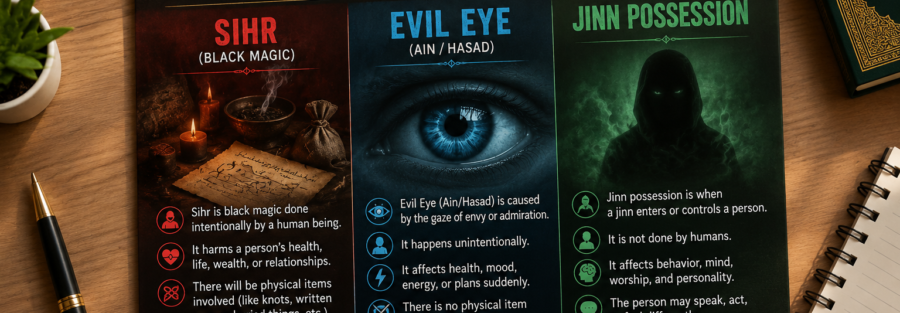
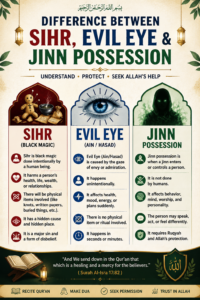
Quick Comparison Table
The following table summarizes the key differences between Sihr (Black Magic), the Evil Eye (Al-‘Ayn), and Jinn Possession. While these conditions may sometimes share similar symptoms, they differ in their causes, means, and the way they are understood in Islam.
| Feature | Sihr (Black Magic) | Evil Eye (Al-‘Ayn) | Jinn Possession |
| Definition | Harm caused through forbidden magical practices, often involving devils (shayaṭeen), by Allah’s permission. | Harm caused by a person’s gaze through envy or admiration, by Allah’s permission. | A situation in which a jinn is believed to enter or exert an extraordinary influence over a person by Allah’s permission. |
| Primary Cause | Magic, spells, unlawful rituals, incantations, knots, talismans, or seeking assistance from devils. | Envy (Hasad), intense admiration, or amazement without remembering Allah. | The exact causes are not definitively detailed in revelation. Classical scholars mention various possibilities while emphasizing that it occurs only by Allah’s permission. |
| Who Causes It? | A magician (saḥir) or someone practicing Sihr. | Any person intentionally or unintentionally. | A jinn, by Allah’s permission, according to the majority of classical scholars. |
| Source of Evidence | Clearly established in the Qur’an and authentic Sunnah. | Clearly established in the Qur’an and authentic Sunnah. | The existence of jinn is established by the Qur’an and Sunnah. The issue of possession has been discussed by scholars, with agreement on some aspects and differences on others. |
| Mentioned in the Qur’an | Yes. For example, Surah Al-Baqarah (2:102) and the story of Prophet Musa (20:65–69). | Yes. Scholars cite verses such as Surah Al-Falaq (113:1–5), Surah Yusuf (12:67), and many classical scholars also discuss Surah Al-Qalam (68:51–52). | Yes. The Qur’an establishes the existence of jinn (51:56) and includes verses discussed by scholars regarding possession, such as 2:275. |
| Mentioned in the Sunnah | Yes. The Prophet ﷺ warned against practicing Sihr and was himself tested with Sihr before Allah cured him. | Yes. The Prophet ﷺ said, “The Evil Eye is real.” (Sahih al-Bukhari; Sahih Muslim). | Yes. Authentic hadith confirm the existence of jinn, Shaytan’s influence, and the permissibility of Ruqyah. |
| Can Affect Physical Health? | Yes, by Allah’s permission. | Yes, by Allah’s permission. | May, according to the majority of classical scholars, though medical causes should also be considered. |
| Can Affect Emotions or Behaviour? | Yes. Some forms of Sihr may influence emotions, relationships, or mental well-being by Allah’s permission. | Yes. The Evil Eye may affect a person’s well-being by Allah’s permission. | Yes, according to the majority scholarly view, while recognizing that medical and psychological conditions can produce similar symptoms. |
| Can Involve Jinn? | Often yes. Many forms of Sihr involve cooperation with devils (shayaṭeen), though not every form necessarily does. | No. The Evil Eye itself does not require the involvement of jinn. | Yes. The condition itself concerns the influence of a jinn. |
| Can They Occur Together? | Yes. A person may experience Sihr alongside the Evil Eye or alleged possession. | Yes. It may occur alongside Sihr or other afflictions. | Yes. Some scholars mention that it may coexist with Sihr or the Evil Eye, although each case requires careful assessment. |
| Treatment | Authentic Ruqyah, sincere du’a, repentance, remembrance of Allah, and lawful medical treatment where appropriate. Avoid magicians and prohibited practices. | Authentic Ruqyah, daily adhkar, du’a, and if known, the Sunnah method involving the one who cast the Evil Eye. | Authentic Ruqyah, remembrance of Allah, du’a, and appropriate medical or psychological care where needed. |
| Prevention | Morning and evening adhkar, Ayat al-Kursi, Surah Al-Baqarah, Surah Al-Ikhlas, Al-Falaq and An-Nas, sincere tawakkul, and avoiding prohibited practices. | Remember Allah when admiring blessings, recite daily adhkar, seek Allah’s protection, and place trust in Him. | Regular Qur’an recitation, daily adhkar, authentic du’as, avoiding sin, maintaining obedience to Allah, and seeking refuge in Him from Shaytan. |
| Ultimate Reality | Can only occur by the permission of Allah. | Can only occur by the permission of Allah. | If it occurs, it can only occur by the permission of Allah. |
Key Takeaway
Although Sihr, the Evil Eye, and Jinn possession are often mentioned together, they are not the same. Sihr is an act of forbidden magic, the Evil Eye results from a harmful gaze by Allah’s permission, and Jinn possession refers to a separate issue discussed by scholars concerning the influence of jinn over a person. Because their symptoms can overlap, self-diagnosis should be approached with caution. Muslims should rely on authentic Islamic guidance, avoid speculation about the unseen, seek lawful Ruqyah where appropriate, and also consult qualified medical professionals when physical or psychological symptoms are present.
Symptoms of Sihr
One of the most common questions people ask is, “What are the symptoms of Sihr (black magic)?” While the Qur’an and authentic Sunnah confirm that Sihr is real, they do not provide a definitive checklist of symptoms by which a person can diagnose themselves. For this reason, Islamic scholars have always advised caution. Many signs commonly attributed to Sihr may also result from medical conditions, psychological illnesses, life stress, or other natural causes.
The symptoms below are commonly mentioned by scholars and experienced practitioners of Ruqyah based on observations over time. They do not prove that a person has Sihr, nor should they replace proper medical evaluation or qualified Islamic guidance.
Spiritual Symptoms
Since Sihr aims to harm a person’s relationship with Allah or disrupt different aspects of life, some individuals may experience changes in their spiritual state.
Possible spiritual symptoms include:
- Sudden difficulty concentrating during Salah.
- Feeling unusually heavy or distracted while reciting the Qur’an.
- Strong aversion to listening to the Qur’an without an apparent reason.
- Forgetfulness regarding acts of worship.
- Persistent feelings of hopelessness that discourage worship.
- Experiencing unusual discomfort during authentic Ruqyah.
It is important to remember that fluctuations in faith happen to every Muslim and are not, by themselves, evidence of Sihr.
Emotional Symptoms
Some people affected by Sihr may experience emotional disturbances by Allah’s permission. These symptoms often overlap with anxiety, depression, trauma, or other psychological conditions.
Possible emotional symptoms include:
- Sudden mood swings without an obvious trigger.
- Persistent sadness or unexplained emotional distress.
- Irritability and anger over minor matters.
- Constant fear or excessive worry.
- Loss of motivation or interest in daily activities.
- Feeling overwhelmed despite no clear external cause.
- Intrusive thoughts that significantly affect daily life.
These symptoms should always be evaluated carefully, as they may have medical or psychological explanations requiring professional care.
Physical Symptoms
Islam acknowledges that Sihr may affect a person’s physical well-being by Allah’s permission. However, physical symptoms alone cannot establish that someone has been affected by Sihr.
Symptoms commonly reported include:
- Persistent headaches with no clear explanation.
- Fatigue despite adequate rest.
- Unexplained body pain or heaviness.
- Sleep disturbances or insomnia.
- Frequent nightmares.
- Loss of appetite or unusual changes in eating habits.
- Sudden weakness or exhaustion.
- Unexplained skin discomfort in some cases.
Because these symptoms are common to many medical conditions, a thorough medical evaluation should never be neglected.
Relationship Symptoms
One of the clearest examples mentioned in the Qur’an concerns Sihr intended to create separation between spouses.
Allah says: “They learned from them that by which they cause separation between a man and his wife. But they cannot harm anyone except by the permission of Allah…” (Qur’an 2:102)
Relationship-related difficulties that are sometimes discussed in relation to Sihr include:
- Sudden and intense conflict between spouses without an obvious cause.
- Strong feelings of dislike toward one’s spouse that appear abruptly.
- Constant misunderstandings despite sincere efforts to reconcile.
- Unexplained reluctance toward marriage or intimacy.
- Repeated breakdown of marriage proposals without clear reasons.
However, marital problems are often caused by communication issues, financial stress, personality differences, or other life circumstances. The existence of relationship difficulties does not automatically indicate Sihr.
Financial and Life Difficulties
Some people believe that repeated setbacks in work, studies, or finances necessarily indicate Sihr. While Islamic scholars acknowledge that Sihr may affect different areas of life by Allah’s permission, Islam does not teach that every hardship is caused by black magic.
People sometimes associate Sihr with:
- Repeated unexplained obstacles despite reasonable effort.
- Sudden business losses without an apparent cause.
- Difficulty maintaining employment.
- Continuous failure despite adequate preparation.
- Unexpected disruptions affecting important life plans.
At the same time, financial hardship, unemployment, academic struggles, and business losses are common tests in life and often have practical explanations. A Muslim should strive to identify natural causes, improve their circumstances through lawful means, and place their trust in Allah.
Important Caution
Perhaps the most important point to understand is that no collection of symptoms can conclusively diagnose Sihr. Many of the signs listed above are also found in medical, neurological, psychological, or emotional conditions. Likewise, everyday life challenges, stress, grief, and personal trials may produce similar experiences.
For this reason:
- Do not diagnose yourself solely based on internet symptom lists.
- Do not assume that every illness, setback, or emotional struggle is caused by Sihr.
- Do not rely on dreams, social media videos, or unverified claims as proof of black magic.
- Seek authentic Ruqyah from someone who follows the Qur’an and Sunnah if there is a genuine reason for concern.
- Consult qualified medical or mental health professionals for physical or psychological symptoms, as spiritual and medical conditions can coexist.
- Place your trust in Allah, remembering that no harm can reach you except by His permission.
A balanced Muslim neither denies the reality of Sihr nor attributes every difficulty to it. The correct approach is to seek knowledge, rely on authentic Islamic guidance, use lawful means of treatment, and remember that ultimate healing comes from Allah alone.
Symptoms of the Evil Eye (Al-‘Ayn)
The Evil Eye (Al-‘Ayn) is a reality established by the Qur’an and authentic Sunnah. However, neither the Qur’an nor the Prophet ﷺ provided a fixed list of symptoms that can conclusively identify someone as being affected by the Evil Eye. As a result, many of the symptoms discussed today are based on the observations of scholars and experienced practitioners of Ruqyah Shariah, not explicit textual evidence.
For this reason, Muslims should avoid diagnosing themselves or others based solely on symptoms. The same physical or emotional difficulties may result from ordinary illnesses, stress, psychological conditions, or other life circumstances. The correct approach is to seek Allah’s help, perform authentic Ruqyah, and pursue appropriate medical care where necessary.
Physical Signs
The Evil Eye may affect a person’s physical well-being by Allah’s permission. While every individual is different, some commonly reported physical signs include:
- Persistent fatigue despite adequate rest.
- A noticeable decline in health despite normal medical investigations.
- Sudden weakness or loss of energy.
- Poor appetite or unexplained weight changes.
- Frequent headaches without an obvious cause.
- Unexplained body aches or heaviness.
- Changes in appetite.
- Difficulty sleeping or disturbed sleep.
- Frequent yawning during Ruqyah or Qur’an recitation in some cases.
- A decline in general health despite normal medical test results.
These symptoms are not unique to the Evil Eye and may have many natural causes. Therefore, they should never be treated as proof that a person has been affected by Al-‘Ayn.
Emotional Signs
Some individuals believed to be affected by the Evil Eye may experience changes in their emotional or mental state by Allah’s permission.
These may include:
- Feeling unusually anxious or emotionally unsettled.
- Persistent sadness without a clear reason.
- Irritability over minor matters.
- Difficulty concentrating.
- Loss of motivation or enthusiasm.
- Feeling mentally exhausted.
- Becoming easily overwhelmed by daily responsibilities.
Since these symptoms are also common in anxiety disorders, depression, burnout, and other psychological conditions, seeking professional medical or mental health evaluation is both appropriate and encouraged when needed.
Family and Wealth Effects
Islamic scholars have mentioned that the Evil Eye may, by Allah’s permission, affect various blessings that a person possesses. This is supported by authentic hadith showing that the Evil Eye can impact individuals, and scholars have extended this understanding to other blessings that Allah grants.
Examples discussed by scholars include:
- Sudden illness affecting a healthy person.
- Unexplained problems within the family.
- Repeated setbacks in work or business.
- Unexpected financial losses.
- Decline in productivity or success.
- Frequent breakdown of valuable possessions.
- Difficulties affecting children, livestock, crops, or property.
It is important to emphasize that these situations do not automatically indicate the Evil Eye. Financial losses may result from economic conditions, business decisions, or unforeseen circumstances. Family conflicts often arise from communication problems or external pressures. Islam teaches believers to avoid attributing every hardship to spiritual causes without evidence.
Caution
One of the greatest mistakes people make is assuming that every blessing lost or every hardship experienced is the result of the Evil Eye. Such assumptions can lead to unnecessary fear, suspicion toward others, and neglect of genuine medical, psychological, or practical solutions.
Keep the following principles in mind:
- No symptom list can confirm the presence of the Evil Eye.
- Only Allah knows the unseen, and no person can state with certainty that another individual has been affected by Al-‘Ayn based solely on symptoms.
- Do not accuse family members, friends, or acquaintances of giving the Evil Eye without clear evidence. False accusations damage relationships and contradict Islamic etiquette.
- Seek protection through the means prescribed in Islam, including morning and evening adhkar, recitation of Surah Al-Ikhlas, Surah Al-Falaq, Surah An-Nas, Ayat al-Kursi, sincere du’a, and authentic Ruqyah.
- Consult qualified healthcare professionals when experiencing physical or psychological symptoms, as medical conditions and spiritual concerns can coexist.
The believer maintains a balanced approach: affirming the reality of the Evil Eye because it is established by the Qur’an and Sunnah, while avoiding superstition, fear, and unsupported conclusions. Ultimate protection and healing belong to Allah alone, and every trial occurs only by His wisdom and permission.
Sihr vs Evil Eye
Although Sihr (black magic) and the Evil Eye (Al-‘Ayn) can produce similar effects, they are not the same. Sihr is a deliberate act of magic performed through forbidden means, often involving devils (Shaitan), by Allah’s permission. The Evil Eye, however, occurs when a person is affected by another’s gaze through envy or admiration, also only by Allah’s permission. The Qur’an explicitly mentions Sihr in Surah Al-Baqarah (2:102), while the Prophet ﷺ said, “The Evil Eye is real.” (Sahih al-Bukhari; Sahih Muslim). Understanding this distinction helps prevent misdiagnosis and encourages Muslims to seek authentic Ruqyah rather than relying on assumptions.
Symptoms of Jinn Possession
Among the topics most frequently discussed in Ruqyah is jinn possession. Many people search for signs of possession after experiencing unusual physical sensations, emotional changes, disturbing dreams, or reactions during Ruqyah. While Islam affirms the existence of jinn, the Qur’an and authentic Sunnah do not provide a definitive symptom checklist for diagnosing jinn possession.
For this reason, great caution is required. The symptoms commonly mentioned below are based on the observations of classical scholars and experienced practitioners of Ruqyah Shariah, not explicit diagnostic criteria from the Qur’an or Sunnah. Similar symptoms may arise from neurological disorders, psychiatric illnesses, sleep disorders, trauma, stress, or other medical conditions.
The purpose of this section is to help readers understand what is commonly discussed in Islamic literature not to encourage self-diagnosis.
During Wakefulness
According to many scholars and practitioners of Ruqyah, some individuals believed to be affected by jinn possession may experience unusual symptoms while awake. These may vary significantly from person to person.
Examples commonly reported include:
- Sudden and unexplained personality changes.
- Temporary Loss of Awareness
- Speaking in an Unknown Language
- Extraordinary Physical Strength
- Responding to Questions as Another Personality
- Episodes of intense anger that seem disproportionate to the situation.
- Feeling as though one’s thoughts or actions are unusually disturbed.
- Aversion to the Mention of Allah
- Violent Body Movements During Ruqyah
- Persistent Internal Conversations
- Hearing whispers encouraging sin, despair, or disbelief beyond ordinary waswasah.
- Strong aversion to hearing the Qur’an or the Adhan without a known medical explanation.
- Unexplained fear in specific places or situations.
- Persistent feelings that cannot be explained by ordinary circumstances.
- In rare reported cases, temporary changes in voice, facial expression, or behaviour during Ruqyah.
It is essential to recognize that many of these symptoms may also occur in medical or psychological conditions. They should never be considered proof of possession without careful assessment.
During Sleep
Sleep-related experiences are often mentioned in discussions of jinn possession. However, dreams alone cannot be used to diagnose possession, as dreams may arise from many different causes.
Some experiences commonly reported include:
- Frequent nightmares.
- Recurring frightening dreams.
- Dreams involving being chased or attacked.
- Disturbing dreams that repeatedly occur over a long period.
- Waking suddenly with intense fear.
- Feeling unusually exhausted despite sleeping.
- Sleep disturbances or difficulty remaining asleep.
These experiences may also be associated with stress, anxiety, trauma, sleep disorders, or other health conditions. Islam encourages believers to recite the prescribed bedtime adhkar, Ayat al-Kursi, and the three Quls before sleeping, regardless of the cause.
During Ruqyah
Some individuals experience reactions while listening to or reciting the Qur’an during authentic Ruqyah. These reactions have been observed by many practitioners, but they do not by themselves establish that a person is possessed by a jinn.
Possible reactions may include:
- Crying or becoming emotional.
- Frequent yawning.
- Feeling unusually hot or cold.
- Trembling or shivering.
- Nausea or an urge to vomit.
- Headache or pressure in certain parts of the body.
- Temporary restlessness.
- Strong emotional release.
- In some reported cases, unusual speech or behavior during Ruqyah.
Such reactions may occur for many reasons. A person may be deeply moved by the Qur’an, emotionally affected, physically tired, or responding to stress. Therefore, a reaction during Ruqyah should never be treated as definitive proof of jinn possession.
Important Disclaimer
Understanding jinn possession requires knowledge, humility, and caution. The unseen belongs to Allah alone, and Muslims are instructed not to make claims without evidence.
Keep the following principles in mind:
- No symptom can conclusively prove jinn possession.
- No single reaction during Ruqyah confirms possession.
- Dreams, nightmares, or sleep paralysis do not automatically indicate the presence of a jinn.
- Medical, neurological, psychiatric, and psychological conditions must always be considered, as many can produce symptoms similar to those discussed in Ruqyah literature.
- Only qualified individuals who adhere to the Qur’an and authentic Sunnah should assess suspected spiritual afflictions, and even then, they should avoid making absolute claims about matters of the unseen.
- Never seek diagnosis or treatment from magicians, fortune-tellers, astrologers, or those who claim certain knowledge of the unseen. Such practices are prohibited in Islam.
- Authentic Ruqyah is a lawful means of seeking Allah’s help, but healing ultimately comes from Allah alone.
A balanced Muslim neither dismisses the possibility of jinn possession nor assumes that every unexplained symptom is caused by jinn. Instead, they combine sincere reliance upon Allah with authentic Ruqyah, daily remembrance, and appropriate medical care whenever needed. This balanced approach is the guidance of the Qur’an, the Sunnah, and the methodology of recognized Islamic scholars.
Evil Eye vs Jinn Possession
The Evil Eye and Jinn possession are separate concepts in Islam. The Evil Eye is harm caused by another person’s gaze through envy or admiration by Allah’s permission. Jinn possession, according to the majority of classical scholars, refers to a jinn influencing or possessing a person by Allah’s permission. While some symptoms may overlap, one does not automatically indicate the other. The Qur’an and authentic Sunnah affirm the reality of both, but they do not provide a symptom checklist to distinguish them. Proper assessment should always be based on authentic Islamic guidance while also considering medical and psychological causes.
Difference Between Black Magic and Evil Eye
The main difference between black magic and the Evil Eye is their source. Black magic (Sihr) is intentionally performed through prohibited rituals, whereas the Evil Eye may occur unintentionally when someone looks at another person with envy or excessive admiration. Sihr often involves a magician, while anyone may unknowingly cast the Evil Eye. Both are real according to Islam, but neither can affect anyone except by the permission of Allah. Muslims are encouraged to protect themselves through daily adhkar, Qur’an recitation, authentic Ruqyah, and sincere trust in Allah.
Black Magic vs Jinn Possession
Black magic (Sihr) and Jinn possession are closely related but not identical. Some forms of Sihr may involve cooperation with devils, while Jinn possession refers to the influence or possession of a person by a jinn according to the majority of classical scholars. A person may experience one without the other, and having Sihr does not automatically mean a jinn is involved. Authentic Ruqyah is prescribed for both, but Muslims should avoid making assumptions about the unseen and seek qualified Islamic guidance alongside appropriate medical care when needed.
Symptoms They Have in Common
One of the primary reasons people confuse Sihr (black magic), the Evil Eye (Al-‘Ayn), and Jinn possession is that they may share similar symptoms. A person experiencing persistent headaches, emotional distress, disturbed sleep, relationship problems, or unusual reactions during Ruqyah may assume they have one particular spiritual affliction. In reality, these symptoms are not exclusive to any single condition and may also result from physical illnesses, psychological disorders, emotional stress, or other life circumstances.
The Qur’an and authentic Sunnah affirm the reality of Sihr, the Evil Eye, and the existence of jinn, but they do not provide a symptom-based diagnostic framework that allows someone to determine which condition they have. This is why scholars consistently advise Muslims to avoid drawing conclusions based solely on symptoms or information found online.
Common Symptoms That May Overlap
The following symptoms are often mentioned in discussions of Sihr, the Evil Eye, and Jinn possession:
- Persistent headaches.
- Unexplained fatigue or weakness.
- Disturbed sleep or insomnia.
- Frequent nightmares.
- Emotional distress, anxiety, or sadness.
- Difficulty concentrating.
- Lack of motivation.
- Feelings of heaviness.
- Unexplained body aches.
- Relationship difficulties.
- Reduced productivity or unexpected setbacks.
- Reactions during Ruqyah, such as crying, yawning, shivering, nausea, or sleepiness.
Because these symptoms appear across discussions of all three conditions, they cannot be used to distinguish one from another.
Why Self-Diagnosis Is Difficult
Many websites and social media posts provide long symptom checklists that suggest a person has Sihr, the Evil Eye, or Jinn possession if they experience several of the listed signs. While such lists may be well-intentioned, they often create unnecessary fear and confusion.
Several factors make self-diagnosis unreliable:
- The symptoms overlap significantly. A headache or nightmare could be discussed in relation to all three conditions.
- Many symptoms are common medical complaints. Fatigue, insomnia, anxiety, chronic pain, and emotional distress frequently occur without any spiritual cause.
- Individuals experience trials differently. Two people affected by the same condition may present completely different symptoms, while two people with similar symptoms may have entirely different underlying causes.
- The unseen belongs to Allah. Human beings cannot determine unseen realities through observation alone.
For these reasons, symptoms should never be treated as proof of any particular spiritual condition.
Similar Symptoms Do Not Mean the Same Cause
Consider the example of persistent fatigue. It may be associated with:
- A medical condition such as anaemia, thyroid disease, or vitamin deficiency.
- Chronic stress or burnout.
- Depression or anxiety.
- Poor sleep habits.
- The ordinary challenges and tests of life.
- A spiritual concern requiring further assessment.
Likewise, nightmares may occur because of stress, trauma, sleep disorders, ordinary dreams, or, in some cases, spiritual factors. Without proper assessment, it is impossible to determine the cause based solely on the symptom.
This is why Islam teaches believers to avoid assumptions and to seek knowledge before making judgments.
Allah says: “And do not pursue that of which you have no knowledge. Indeed, the hearing, the sight and the heart about all those ones will be questioned.”
(Qur’an 17:36)
This verse serves as an important principle when discussing matters of the unseen. Muslims should not claim certainty where Allah and His Messenger ﷺ have not provided definitive evidence.
The Balanced Islamic Approach
When someone experiences persistent or unexplained symptoms, Islam encourages a balanced response rather than choosing between spiritual and worldly means.
A believer should:
- Turn to Allah through sincere du’a and repentance.
- Maintain the morning and evening adhkar.
- Recite the Qur’an regularly, especially Ayat al-Kursi, Surah Al-Baqarah, Surah Al-Ikhlas, Surah Al-Falaq, and Surah An-Nas.
- Perform or seek authentic Ruqyah Shariah if there is genuine reason for concern.
- Consult qualified medical or mental health professionals to evaluate physical or psychological symptoms.
- Avoid magicians, fortune-tellers, and individuals who make absolute claims about the unseen.
The fact that Sihr, the Evil Eye, and Jinn possession may share certain symptoms does not mean they are the same condition. Nor does it mean that a person experiencing these symptoms has a spiritual affliction. The overlap between them and with many medical and psychological conditions is precisely why self-diagnosis is unreliable.
The safest and most authentic approach is to rely upon the Qur’an and Sunnah, seek lawful Ruqyah where appropriate, pursue necessary medical care, and place complete trust in Allah. Ultimate knowledge of the unseen belongs to Him alone, and He is the One who grants both protection and healing.
Can Someone Have Sihr, the Evil Eye, and Jinn Possession at the Same Time?
This is one of the most frequently asked questions in Ruqyah, and the short answer is yes, it is possible, according to many classical scholars and experienced practitioners of Ruqyah Shariah. However, the presence of one condition does not automatically mean the other two are also present.
The Qur’an and authentic Sunnah affirm the reality of Sihr (black magic), the Evil Eye (Al-‘Ayn), and the existence of jinn. These are separate matters with different causes and characteristics. While they may coexist in some cases, Islam does not teach that they always occur together or that one necessarily leads to another.
Scholars Mention That Coexistence Is Possible
Many classical scholars explained that a person may experience more than one type of spiritual affliction at the same time because each has a different origin.
For example:
- A person may be affected by the Evil Eye due to another person’s envy or admiration.
- The same person may later become the target of Sihr performed by a magician.
- According to the majority of classical scholars, if Allah permits, a jinn may also become involved in certain cases, particularly those related to some forms of Sihr.
Because these are separate issues, scholars have acknowledged that their coexistence is possible. However, this possibility should never be treated as the default assumption for every individual seeking Ruqyah.
One Condition Does Not Automatically Prove Another
A common mistake is assuming that confirming one spiritual affliction automatically confirms the others.
For example:
- Having the Evil Eye does not mean a person also has Sihr.
- Having Sihr does not necessarily mean a jinn is possessing the person.
- A reaction during Ruqyah does not automatically prove either Sihr or jinn possession.
- Recurring nightmares alone do not establish the presence of any of these conditions.
Each issue should be understood independently and assessed on its own merits. Jumping from one conclusion to another without evidence often creates unnecessary fear and confusion.
Similarly, if a person improves after Ruqyah, it does not always reveal the exact nature of the original problem. Allah may grant relief through the Qur’an for a variety of spiritual, emotional, or psychological struggles, because the Qur’an is a source of guidance, mercy, and healing for believers.
Proper Assessment Should Avoid Assumptions
Islam teaches believers to exercise caution when speaking about matters of the unseen. While experienced practitioners of Ruqyah Shariah may identify patterns that suggest further investigation, no one can state with certainty that a person has Sihr, the Evil Eye, or jinn possession based solely on symptoms or reactions.
A balanced assessment should consider:
- The person’s medical history.
- Psychological or emotional factors.
- Family and social circumstances.
- The presence or absence of evidence from the Qur’an and Sunnah.
- The individual’s response to authentic Ruqyah.
- The possibility that more than one factor may be contributing to their condition.
Qualified practitioners should avoid making dramatic claims or guaranteeing diagnoses. Instead, they should encourage sincere worship, regular Qur’an recitation, authentic Ruqyah, lawful treatment, and complete reliance upon Allah.
Avoid Two Common Extremes
When discussing spiritual afflictions, Muslims should avoid two opposite mistakes:
The first extreme is denying the reality of Sihr, the Evil Eye, or jinn despite the clear evidence found in the Qur’an and authentic Sunnah.
The second extreme is attributing every illness, hardship, emotional struggle, or family problem to one or more of these conditions without evidence.
The guidance of Islam lies between these two extremes. A believer acknowledges the reality of the unseen as revealed by Allah while also recognizing that many difficulties have natural, medical, psychological, or social causes.
Key Takeaway
A person may experience Sihr, the Evil Eye, and, according to the majority of classical scholars, jinn possession at the same time. Nevertheless, the existence of one condition does not automatically prove the presence of another. Every case is unique and should be approached with knowledge, patience, and caution.
Rather than relying on assumptions or sensational claims, Muslims should seek authentic Ruqyah Shariah, pursue appropriate medical care where needed, increase their worship and remembrance of Allah, and remember that ultimate healing and protection come from Allah alone. No spiritual affliction can benefit or harm except by His permission.
How Ruqyah Helps
After learning about Sihr (black magic), the Evil Eye (Al-‘Ayn), and Jinn possession, many people ask the next important question: How does Ruqyah help?
Ruqyah Shariah is one of the greatest means of seeking healing that Allah has prescribed. It is an act of worship based upon the Qur’an, authentic supplications (du’as), and sincere reliance upon Allah (tawakkul). It is not magic, a mystical ritual, or a guaranteed cure. Rather, it is a lawful means through which a believer seeks Allah’s protection, mercy, and healing.
Just as Muslims take medicine while believing that Allah is the One who grants recovery, they perform Ruqyah while believing that healing comes from Allah alone.
What is Ruqyah?
The Arabic word Ruqyah (الرُّقْيَة) refers to reciting verses of the Qur’an and authentic supplications for the purpose of seeking Allah’s protection and healing.
The Prophet ﷺ approved Ruqyah that was free from shirk. He said:
“Present your Ruqyah to me. There is nothing wrong with Ruqyah so long as it does not involve shirk.”
(Sahih Muslim)
Authentic Ruqyah is therefore an act of worship that must meet three essential conditions:
- It consists of the Words of Allah, His Names and Attributes, or authentic supplications from the Sunnah.
- It is performed in a language whose meaning is understood, particularly Arabic when reciting the Qur’an.
- The person performing Ruqyah believes that Allah alone is the One who heals, while the recitation is merely a lawful means.
Any practice involving talismans, unknown symbols, magical rituals, charms, calling upon jinn, seeking help from the dead, or invoking anyone besides Allah falls outside Ruqyah Shariah and is prohibited in Islam.
Qur’anic Healing
The Qur’an describes itself as a source of guidance, mercy, and healing for believers.
Allah says:
“And We send down of the Qur’an that which is a healing and a mercy for the believers…” (Qur’an 17:82)
Allah also says:
“O mankind! There has come to you an instruction from your Lord, a healing for what is in the hearts, guidance and mercy for the believers.” (Qur’an 10:57)
These verses show that the Qur’an provides healing by Allah’s permission. This healing includes spiritual ailments and, by Allah’s will, may also bring comfort and relief during physical and emotional trials.
The Prophet ﷺ himself performed Ruqyah using the Qur’an and authentic supplications, demonstrating that seeking healing through Allah’s words is part of the Sunnah.
Authentic Ruqyah
Authentic Ruqyah Shariah follows the guidance of the Qur’an and Sunnah without introducing innovations or prohibited practices.
Commonly recited passages include:
- Surah Al-Fatihah
- Ayat al-Kursi (2:255)
- The last two verses of Surah Al-Baqarah (2:285–286)
- Surah Al-Ikhlas
- Surah Al-Falaq
- Surah An-Nas
The Prophet ﷺ regularly recited Surah Al-Ikhlas, Surah Al-Falaq, and Surah An-Nas, blew lightly into his hands, and wiped them over his body before sleeping.
It is also permissible to recite the Qur’an over water or olive oil and use them as part of Ruqyah, provided the practice remains within the limits of the Qur’an and Sunnah and does not involve superstitious beliefs or prohibited acts.
Importantly, every Muslim may perform Ruqyah for themselves or their family members. While knowledgeable Raaqi’s may assist in difficult cases, Ruqyah is not restricted to specialists.
What Ruqyah Can Do
By Allah’s permission, Ruqyah may:
- Strengthen a person’s relationship with Allah.
- Protect against the Evil Eye, Sihr, and the whispers of Shaytan.
- Bring comfort during times of distress.
- Help relieve spiritual afflictions by Allah’s will.
- Increase tranquillity and reliance upon Allah.
- Encourage repentance, remembrance, and regular worship.
- Serve as a means of seeking Allah’s healing alongside lawful medical treatment.
Many people also find that regular Qur’an recitation and authentic Ruqyah improve their spiritual well-being, even when their difficulties are not caused by Sihr, the Evil Eye, or jinn. This is because the Qur’an benefits every believer.
What Ruqyah Does Not Guarantee
Although Ruqyah is a powerful act of worship, it should never be viewed as a guaranteed cure or a method of diagnosing unseen matters.
Ruqyah does not guarantee:
- Immediate healing.
- A specific diagnosis.
- Proof that a person has Sihr, the Evil Eye, or jinn possession.
- That every reaction during Ruqyah is caused by a spiritual affliction.
- That medical treatment is unnecessary.
The Prophet ﷺ taught Muslims to combine trust in Allah with lawful means. Therefore, seeking medical care, psychological support, or other permissible treatment does not contradict reliance upon Allah. Physical, psychological, and spiritual factors may exist together, and addressing one does not exclude the others.
Believers should also be cautious of individuals who:
- Claim to know the unseen.
- Guarantee healing within a fixed number of sessions.
- Diagnose every client with Sihr or possession.
- Demand large sums of money while making extraordinary promises.
- Use talismans, secret symbols, numerology, astrology, or other prohibited practices.
These methods are not part of Ruqyah Shariah and have no basis in the authentic teachings of Islam.
The Ultimate Source of Healing
The greatest lesson of Ruqyah is that Allah alone is Ash-Shāfī (The Healer). The Qur’an is a means of healing, the Raaqi is only a means, and every permissible treatment is merely a means. None of these have independent power.
As Prophet Ibrahim (peace be upon him) declared:
“And when I am ill, it is He who cures me.”
(Qur’an 26:80)
Whether a person is tested with Sihr, the Evil Eye, jinn possession, illness, or any other hardship, their heart should remain attached to Allah. Through sincere faith, authentic Ruqyah, patience, lawful treatment, and continuous du’a, the believer places complete trust in the One in whose Hand lies all healing, protection, and mercy.
When Should You Seek Help?
Experiencing persistent physical, emotional, or spiritual difficulties can be distressing, especially when the cause is unclear. Some people immediately assume they have Sihr (black magic), the Evil Eye (Al-‘Ayn), or Jinn possession, while others dismiss the possibility of any spiritual cause altogether. Islam teaches a balanced approach acknowledging the reality of the unseen while also recognizing that many illnesses and hardships have natural causes.
The Prophet ﷺ encouraged believers to seek treatment while placing their trust in Allah.
This hadith reminds Muslims that seeking help is not a sign of weak faith. Rather, it is part of relying upon the lawful means that Allah has created while knowing that ultimate healing comes from Him alone.
Seek Qualified Islamic Guidance When Appropriate
If you have genuine concerns about a possible spiritual affliction, seek guidance from someone who practices Ruqyah Shariah according to the Qur’an and authentic Sunnah.
A trustworthy Raaqi should:
- Base Ruqyah entirely on the Qur’an and authentic supplications.
- Encourage sincere worship, repentance, and remembrance of Allah.
- Avoid making absolute claims about the unseen.
- Never guarantee healing or promise results within a specific number of sessions.
- Encourage lawful medical treatment when appropriate.
- Avoid talismans, amulets, numerology, astrology, magic, or seeking help from jinn.
Unfortunately, some individuals exploit vulnerable people by claiming extraordinary abilities or certain knowledge of the unseen. Islam clearly warns against fortune-tellers, magicians, and anyone who claims knowledge that belongs only to Allah.
Remember that every Muslim can perform Ruqyah for themselves by reciting the Qur’an and authentic supplications. Seeking help from a qualified Raaqi may be beneficial in some situations, but it is not a requirement for every case.
Seek Medical and Psychological Evaluation
Many symptoms commonly associated with Sihr, the Evil Eye, or Jinn possession such as headaches, chronic fatigue, anxiety, depression, insomnia, panic attacks, mood changes, or unusual behaviour may also result from medical, neurological, or psychological conditions.
For this reason, Islam encourages believers to seek appropriate medical evaluation rather than assuming a spiritual cause.
You should consult a qualified healthcare professional if you experience:
- Persistent or worsening physical symptoms.
- Severe pain or unexplained illness.
- Significant changes in mood or behaviour.
- Symptoms of anxiety or depression.
- Hallucinations or confusion.
- Sleep disorders affecting daily life.
- Thoughts of self-harm or harming others.
- Any condition that interferes with normal daily functioning.
Seeking medical care does not contradict belief in the Qur’an, Ruqyah, or Allah’s power to heal. In fact, pursuing lawful treatment is part of following the Sunnah.
Physical, Psychological, and Spiritual Issues Can Coexist
One of the greatest misconceptions is believing that a problem must be either spiritual or medical. In reality, more than one factor may exist at the same time.
For example:
- A person affected by the Evil Eye may also develop anxiety because of prolonged stress.
- Someone suffering from a chronic medical illness may experience spiritual weakness and benefit from increased Qur’an recitation and Ruqyah.
- A person experiencing depression may require professional mental health support while also finding comfort in worship, du’a, and remembrance of Allah.
These possibilities do not contradict one another. Allah has created both spiritual and worldly means, and a believer benefits from both while maintaining complete trust in Him.
Warning Signs of Unreliable Practitioners
Be cautious of anyone who:
- Diagnoses every person with Sihr or Jinn possession after a brief conversation.
- Claims certain knowledge of the unseen.
- Demands large sums of money while guaranteeing healing.
- Uses talismans, written symbols, charms, astrology, or unknown incantations.
- Asks for your mother’s name, personal clothing, hair, or photographs for rituals.
- Instructs you to perform acts that contradict the Qur’an or Sunnah.
- Discourages you from seeking medical treatment.
Such practices have no basis in authentic Ruqyah Shariah and may involve prohibited or deceptive methods.
The Best Course of Action
If you are experiencing unexplained symptoms or ongoing hardship:
- Increase your daily worship and strengthen your relationship with Allah.
- Maintain the morning and evening adhkar.
- Recite the Qur’an regularly, especially Surah Al-Baqarah, Ayat al-Kursi, Surah Al-Ikhlas, Surah Al-Falaq, and Surah An-Nas.
- Perform Ruqyah for yourself or seek help from a qualified practitioner who follows the Qur’an and Sunnah.
- Consult qualified medical or mental health professionals when symptoms suggest a physical or psychological condition.
- Be patient and place your trust in Allah, knowing that every trial occurs by His wisdom and every cure is in His Hand.
Islam does not ask believers to choose between faith and medicine. Instead, it teaches them to combine authentic Ruqyah, sincere du’a, remembrance of Allah, and appropriate medical and psychological care whenever needed.
Whether the cause of your difficulties is spiritual, physical, psychological, or a combination of these, remember that Allah alone is Ash-Shāfī (The Healer). Every lawful treatment is only a means, and true healing comes only by His permission.